Vitamin D and Bone Health: What Really Works for Strong Bones
 Nov, 26 2025
Vitamin D isn’t just a supplement you take to avoid getting sick in winter. It’s the key player in keeping your bones strong, reducing fracture risk, and even helping you stay steady on your feet as you age. But here’s the twist: more isn’t always better. For years, doctors told everyone to pop high-dose vitamin D pills daily. Now, new research shows that for many healthy adults, that advice might be doing more harm than good.
Why Vitamin D Matters for Your Bones
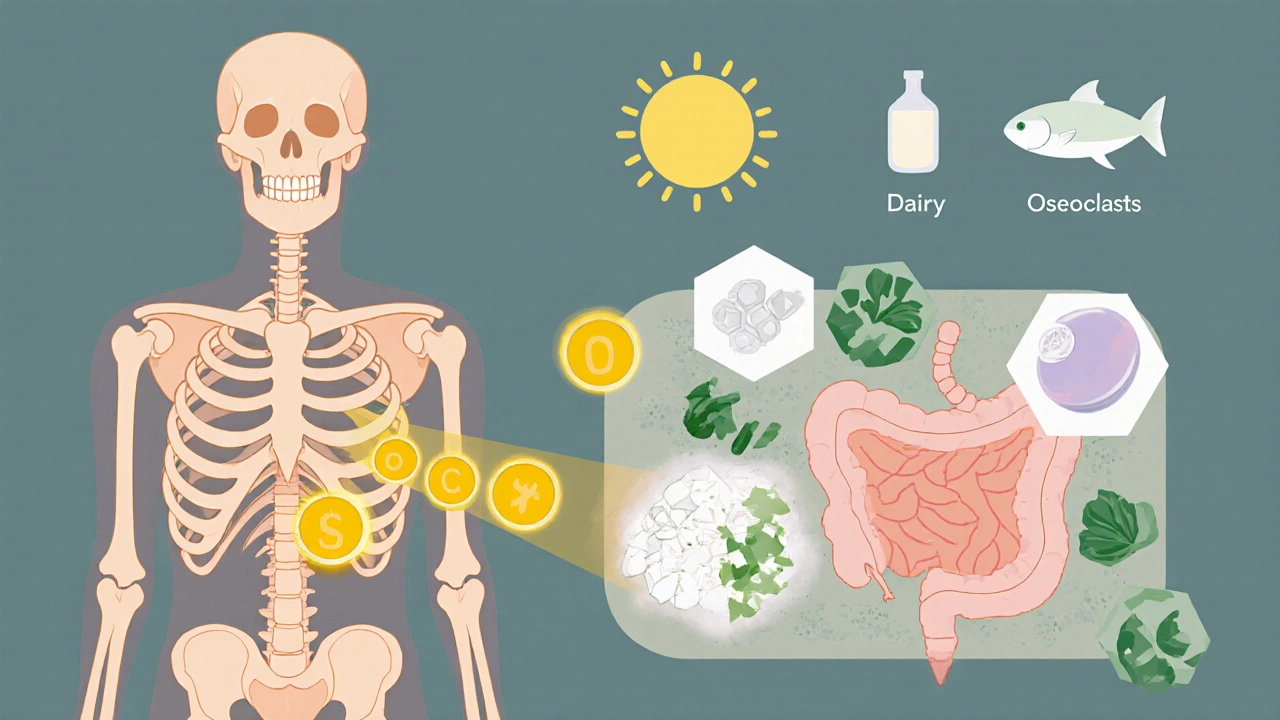
Your bones aren’t static-they’re constantly being broken down and rebuilt. Vitamin D makes that process work. Without enough of it, your body can’t absorb calcium properly. Instead of getting 60-80% of the calcium from your food, you’re lucky to absorb 10-15%. That’s like trying to build a house with half the bricks you need.
It’s not just about calcium, though. Vitamin D also helps keep your muscles strong. Weak muscles mean more falls. And falls, especially in older adults, are the leading cause of hip fractures. So vitamin D does three things: helps your gut absorb calcium, tells your bones how to mineralize properly, and keeps your legs steady so you don’t trip.
What’s the Right Level? The Numbers That Matter
Doctors measure vitamin D status by testing your blood for 25-hydroxyvitamin D, or 25(OH)D. For decades, the standard was simple: below 20 ng/mL? Deficient. Between 21-29? Insufficient. 30 or higher? Good to go.
But that 30 ng/mL target? It’s being questioned. The VITAL trial, a massive 5-year study led by Harvard Medical School, found no extra bone protection for people who took 2,000 IU daily-even if their levels went from 25 to 40 ng/mL. In fact, people who started with normal levels saw no benefit at all. The only group that showed a tiny improvement were those who began with very low levels-below 14.2 pmol/L.
That’s a game-changer. It suggests that if you’re not deficient, extra vitamin D won’t make your bones stronger. And if you’re already getting enough from food, sun, or a low-dose supplement, more might not help-and could hurt.
The High-Dose Trap: When More Vitamin D Weakens Bones
Here’s the shocking part: taking too much vitamin D might actually make your bones weaker.
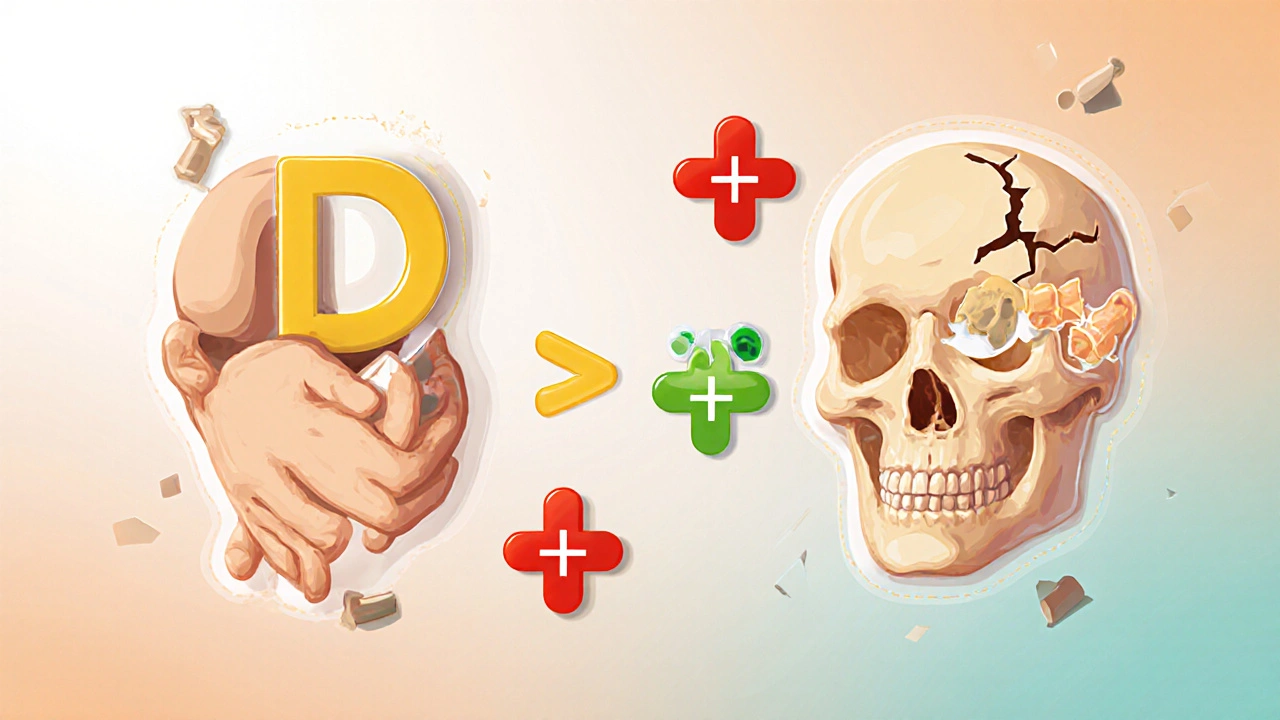
A 2020 JAMA study gave people 400 IU, 4,000 IU, or 10,000 IU daily for three years. Those on the highest dose (10,000 IU) ended up with significantly lower bone density in their radius and tibia compared to those on 400 IU. That’s not a fluke. It’s a direct negative effect.
Why does this happen? Too much vitamin D can overstimulate bone turnover. Your body breaks down bone faster than it rebuilds it. It’s like constantly tearing down a wall to rebuild it-but never finishing the new layer. The result? Thinner, more fragile bones.
And it’s not just lab numbers. Real people report it too. On health forums, users who took 10,000 IU daily for years saw their femoral neck bone density drop by over 3%. One person saw a 2.1% gain on 5,000 IU-but that’s the exception, not the rule.
Supplements Alone Won’t Cut It: The Calcium Connection
Vitamin D doesn’t work in a vacuum. It needs calcium. And here’s the catch: taking calcium with vitamin D only helps if you’re not already getting enough from your diet.
A 2023 meta-analysis found that when people took calcium and vitamin D together, their total fracture risk dropped by 15%, and hip fractures by 30%. But only if they were getting less than 400 IU of vitamin D daily. At higher doses, the benefit vanished. In fact, higher doses showed no change in femoral neck bone density-meaning the combo only works when you’re underdosing vitamin D, not overdosing.
That’s why experts now say: if you’re low on calcium, fix that first. Eat more dairy, leafy greens, sardines, or fortified foods. Then, if your vitamin D is still low, add a small supplement. Don’t start with mega-doses.
Who Actually Needs Supplementation?
Not everyone needs a pill. If you’re healthy, eat fish a few times a week, drink fortified milk, and get 10-15 minutes of midday sun on your arms and face a few times a week-you’re probably fine.
But here are the groups that truly benefit from supplements:
- People over 65 with low sun exposure
- Those with dark skin living in northern latitudes
- People with obesity (BMI ≥30)-fat tissue traps vitamin D, so they need double the dose
- Anyone diagnosed with osteoporosis or a history of fractures
- People taking medications like corticosteroids that weaken bones
For these groups, 800-1,000 IU daily is usually enough. The Endocrine Society suggests 1,500-2,000 IU for people with deficiency, but only after testing confirms it.
How to Take Vitamin D Right
Timing matters. Vitamin D is fat-soluble. Taking it on an empty stomach? You absorb maybe 30%. Take it with your biggest meal-especially one with fat-and absorption jumps by over 50%.
Also, wait three months after changing your dose before retesting. Your blood levels don’t stabilize right away. Testing too soon gives you a false reading.
And don’t assume your supplement is accurate. ConsumerLab’s 2022 review found 15% of vitamin D supplements contained less than 90% of the labeled amount. One brand had only 72%. Another? It had 128% more than stated. Stick to brands with third-party testing-USP, NSF, or ConsumerLab certified.
D3 vs. D2: Which One Should You Choose?
There are two forms: D2 (from plants) and D3 (from animals or sunlight). D3 is the winner. A 2011 study showed it’s 87% more effective at raising blood levels of 25(OH)D. So if you’re supplementing, go for D3. Vegan? Look for lichen-derived D3-it’s plant-based and just as effective.
What About Sunlight?
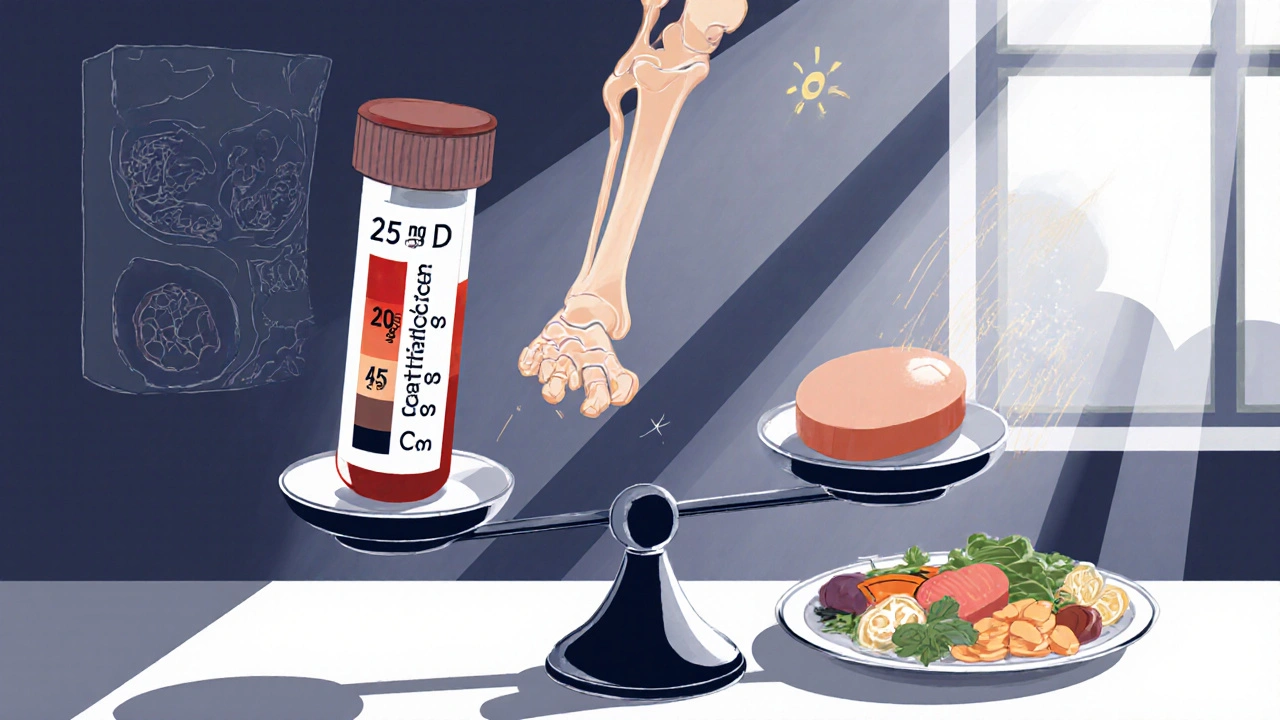
Your skin makes vitamin D when exposed to UVB rays. But it’s not simple. In winter, especially north of Atlanta, you won’t make any vitamin D from the sun, no matter how long you sit outside. Cloud cover, pollution, sunscreen, and skin tone all block it. Darker skin needs 3-6 times longer exposure than lighter skin to make the same amount.
That’s why supplements are often necessary. But don’t skip the sun entirely. Even 10 minutes a day, arms and face exposed, helps. It’s not just about vitamin D-it’s about circadian rhythm, mood, and overall health.
The Bottom Line: Less Is Often More
The old advice-‘take 2,000 IU daily for strong bones’-is outdated. For most healthy adults, it’s unnecessary. For some, it’s dangerous.
Here’s what you should do instead:
- Get tested if you’re at risk: over 65, dark skin, obese, limited sun, or have a history of fractures.
- If your level is below 20 ng/mL, talk to your doctor about 1,000-2,000 IU daily for 3 months, then retest.
- If your level is 20-30 ng/mL, 800 IU daily is enough.
- If your level is above 30 ng/mL, you likely don’t need a supplement unless you’re in a high-risk group.
- Always pair vitamin D with adequate calcium from food-don’t rely on pills alone.
- Avoid doses over 4,000 IU daily unless under medical supervision.
The goal isn’t to hit the highest number possible. It’s to stay in the sweet spot: enough to support your bones, but not so much that you start breaking them down.
What’s Next? Personalized Vitamin D
The future of bone health isn’t one-size-fits-all. Researchers are now looking at genetics, BMI, and baseline levels to tailor doses. Some people metabolize vitamin D faster. Others store it poorly. A 2023 NIH statement called for individualized plans-and that’s where we’re headed.
For now, the best approach is simple: test before you supplement. Eat well. Get safe sun. And skip the mega-doses unless you’re truly deficient. Your bones will thank you.
Can vitamin D supplements prevent fractures in healthy older adults?
For healthy older adults with normal vitamin D levels, daily supplements of 800-2,000 IU show no significant reduction in fracture risk. The VITAL trial found no difference in fracture rates between those taking 2,000 IU daily and those taking placebo over five years. Benefits are seen only in people with documented deficiency or very low baseline levels.
Is 5,000 IU of vitamin D daily too much?
For most people, 5,000 IU daily is unnecessary and potentially harmful. While it’s not toxic at this level, studies show that doses above 4,000 IU daily can lead to lower bone mineral density over time. Only people with severe deficiency, obesity, or malabsorption should take this dose-and only under medical supervision with regular blood testing.
Should I take vitamin D with calcium?
Only if you’re not getting enough calcium from food. If your diet is low in dairy, leafy greens, or fortified foods, combining 800 IU vitamin D with 1,000-1,200 mg calcium daily can reduce fracture risk. But if you’re already meeting calcium needs, adding more calcium won’t help-and may cause constipation or kidney stones. Focus on food first.
How do I know if I’m deficient in vitamin D?
The only reliable way is a blood test for 25-hydroxyvitamin D. Levels below 20 ng/mL (50 nmol/L) indicate deficiency. Symptoms like bone pain or muscle weakness are unreliable-many people with low levels feel fine. If you’re over 65, have dark skin, are obese, or avoid the sun, get tested even if you feel okay.
Can I get enough vitamin D from food alone?
It’s very hard. Even the best dietary sources-like salmon (570 IU per 3 oz), fortified milk (100 IU per cup), or egg yolks (44 IU per yolk)-don’t add up to the 600-800 IU daily recommendation without supplementation. Most people need at least a low-dose supplement, especially in winter or if they have limited sun exposure.
Sue Haskett
November 27, 2025 AT 02:28Wow, this is so needed-finally someone says it plainly: more isn’t better. I used to take 5,000 IU daily because I thought I was being "proactive"-turns out, I was just wasting money and possibly weakening my bones. I got tested last year, my level was 32 ng/mL-and I stopped cold. My hip pain? Gone. My energy? Better. Don’t over-supplement unless you have a real deficiency.
Jauregui Goudy
November 28, 2025 AT 20:58THIS. IS. THE. TRUTH. 🙌 I’m a physical therapist-saw 12 patients in the last month with low bone density who were taking 10,000 IU daily. All of them. No joke. One guy had a stress fracture from walking too much-he thought he was being healthy. Spoiler: he wasn’t. Vitamin D isn’t a magic bullet-it’s a tool. Use it right. Or don’t use it at all.
Rhiana Grob
November 30, 2025 AT 00:49Thank you for this nuanced, evidence-based breakdown. Too often, health advice devolves into dogma. The VITAL trial findings are critical, and the JAMA study on bone density loss at high doses is alarming. I’ve shared this with my elderly patients who were on megadoses. The shift from "more is better" to "enough is enough" is long overdue in public health messaging.
Frances Melendez
December 1, 2025 AT 19:44Of course you’re telling people to skip supplements-because Big Pharma doesn’t want you to get strong from sunlight and food, right? Everyone knows the government and doctors are in on it. You think I don’t know that 90% of "studies" are funded by pill companies? You’re just parroting the propaganda. I take 10,000 IU because I feel better-and I don’t need a lab test to tell me what my body knows.
Jonah Thunderbolt
December 2, 2025 AT 03:47OMG I’m literally crying rn 🥹 I was taking 10k IU for 3 years and now I’m reading this and my bones are like... "what even is a skeleton anymore?" 😭 Also, I just found out my supplement had 128% more than labeled-so I was basically doing a 12,800 IU dose? That’s not a supplement, that’s a bone murder weapon 💀 I’m switching to USP-certified now. And yes, I took it on an empty stomach. Dumb. So dumb.
Rebecca Price
December 4, 2025 AT 01:22Let’s be honest: most people don’t need supplements. I’m 58, live in Portland, and get maybe 10 minutes of sun on my face three times a week. I eat yogurt, sardines, and fortified oatmeal. My vitamin D is 34 ng/mL. I take zero pills. Why? Because I don’t need them. The real problem isn’t vitamin D-it’s our obsession with fixing everything with a pill. Food. Sun. Movement. That’s the triad. Not a bottle.
shawn monroe
December 4, 2025 AT 11:30Key point: D3 > D2. 87% more efficacious per 2011 meta-analysis. Also, fat-soluble = take with lipid-rich meal. Absorption jumps from 30% to 50-60%. And yes, 15% of supplements are mislabeled-ConsumerLab’s 2022 data confirms this. If you’re supplementing, go USP or NSF. Otherwise, you’re gambling with your endocrine system. And don’t forget: BMI ≥30 = 2x dose needed. Adipose sequesters D. It’s not a myth-it’s physiology.
marie HUREL
December 4, 2025 AT 14:38I never thought about how vitamin D affects muscle strength too. I’ve been falling more lately and assumed it was just getting older. But now I realize maybe my muscles were weak because I wasn’t absorbing calcium properly. I got tested and I was at 22 ng/mL. Started 800 IU with dinner and my balance feels better. No dramatic change, just… steadier. I think that’s enough.
Lauren Zableckis
December 6, 2025 AT 09:50I’ve been taking 2,000 IU daily for 5 years. I’m 71. No fractures. No bone pain. No supplements since 2021. I walk outside every morning. Eat cheese. Drink milk. I don’t test. I don’t overthink. I just live. Maybe the real answer is simple: move, eat real food, and stop chasing numbers.
Asha Jijen
December 7, 2025 AT 18:05Edward Batchelder
December 8, 2025 AT 16:44I love how this post balances science with practicality. I’ve been telling my community group this for years: vitamin D isn’t a cure-all, it’s a support system. And sunlight? It’s not just about vitamin D-it’s about serotonin, circadian rhythm, and mental health. I take my 10-minute walk every day at noon. No pills. No guilt. Just presence. That’s the real supplement.
reshmi mahi
December 8, 2025 AT 18:12laura lauraa
December 9, 2025 AT 01:54It is, of course, profoundly tragic that we have reduced the sublime, existential necessity of bone integrity-this sacred, mineralized architecture of the human form-to a mere biochemical metric, a number on a lab slip. We have forgotten that the body is not a machine to be calibrated, but a symphony to be harmonized. And yet, we chase ng/mL like it is the Holy Grail, ignoring the soul of health: rhythm, reverence, and the quiet dignity of sunlight on skin. How far we have fallen.
Mira Adam
December 10, 2025 AT 07:56So you’re telling me that after decades of being told to take 2,000 IU daily, I was being manipulated by the medical-industrial complex? That my bone density decline wasn’t aging-it was vitamin D toxicity? And now I’m supposed to trust a single study? What about the 10,000 other people who feel better on high doses? You can’t dismiss anecdotal evidence just because it doesn’t fit your RCTs. This is science worship, not science.