Using Food Diaries on Warfarin: Tracking Vitamin K for Safety
 Nov, 9 2025
Vitamin K Intake Tracker
Why This Matters
Consistent vitamin K intake is critical for stable INR levels. Sudden changes can cause dangerous bleeding or clotting risks.
Daily Vitamin K Intake
Food Log
When you're on warfarin, your life isn't just about taking a pill every day. It's about what you eat, when you eat it, and how much vitamin K is in it. One small change in your broccoli intake can throw your INR off balance-and that’s not just a lab number. It’s your risk of a blood clot or a dangerous bleed. The fix isn’t avoiding vitamin K altogether. It’s keeping it steady. That’s where a food diary comes in.
Why Vitamin K Matters More Than You Think
Warfarin works by blocking vitamin K from helping your blood clot. Too much vitamin K? Warfarin can’t do its job. Too little? Your blood gets too thin. The goal isn’t to eliminate vitamin K-it’s to keep your intake consistent. The American Heart Association says adult women need 90 micrograms a day, men need 120. But if you normally eat 100 mcg daily and suddenly eat 300 mcg because you had a big salad, your INR can drop fast. A 20% swing from your usual intake is enough to cause trouble.Some foods are packed with vitamin K. One cup of cooked kale has over 800 mcg. Spinach? Nearly 500. Broccoli? Over 200. Even a single serving of these can hit your daily limit in one meal. And it’s not just greens. Soybean oil, canola oil, and fortified drinks like Ensure contain hidden vitamin K. Most people don’t realize how much they’re consuming until they start tracking.
Paper Diaries: Simple, But Easy to Lose
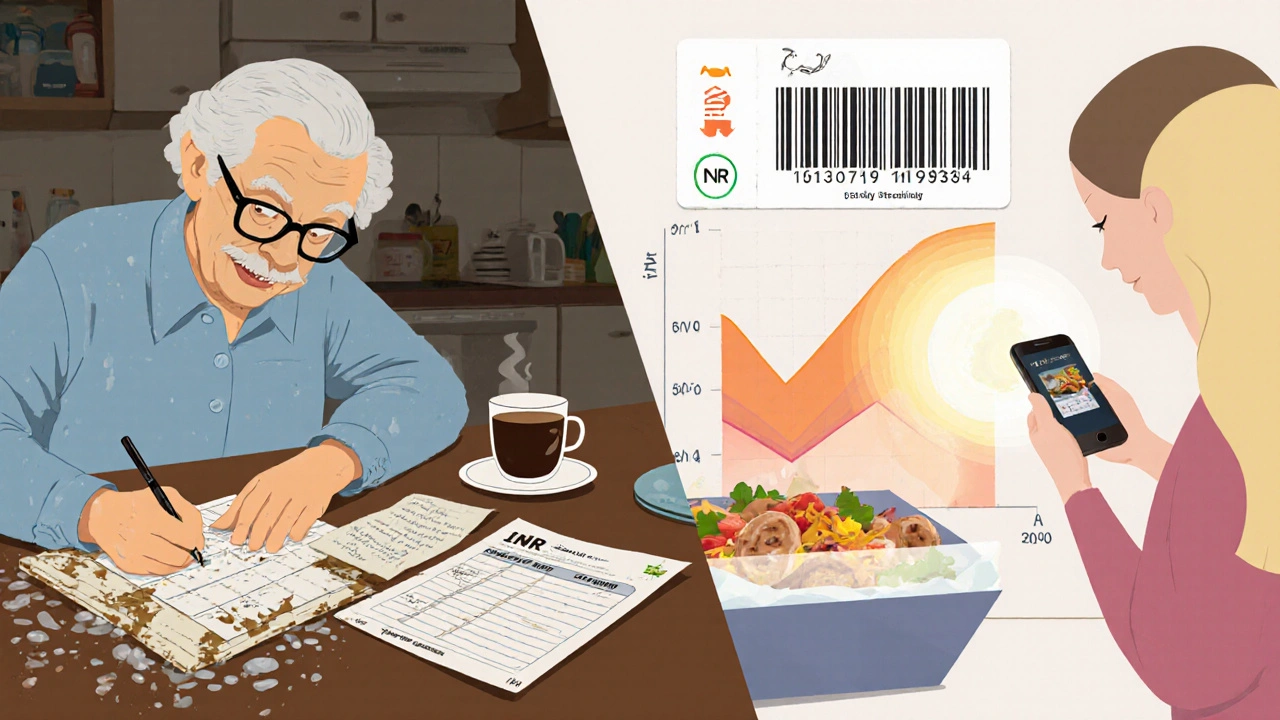
For years, paper diaries were the only option. You’d write down what you ate, how much, and your INR number from your last checkup. The Anticoagulation Forum created a standard format: date, food, portion, estimated vitamin K, INR. Simple. Reliable. But here’s the problem-people forget. They lose the notebook. They get busy. One Veterans Health Administration study found that 43% of clinics still use paper logs, but adherence drops sharply after the first month.Patients over 75 are more likely to stick with paper. Why? Because smartphones are intimidating. Typing in meals feels like homework. One user on Reddit said their paper diary got soggy in their pocket and lost two weeks of data. That’s not just inconvenient-it’s dangerous. If your doctor doesn’t see your real eating patterns, they can’t adjust your dose properly.
Digital Diaries: The Real Game-Changer
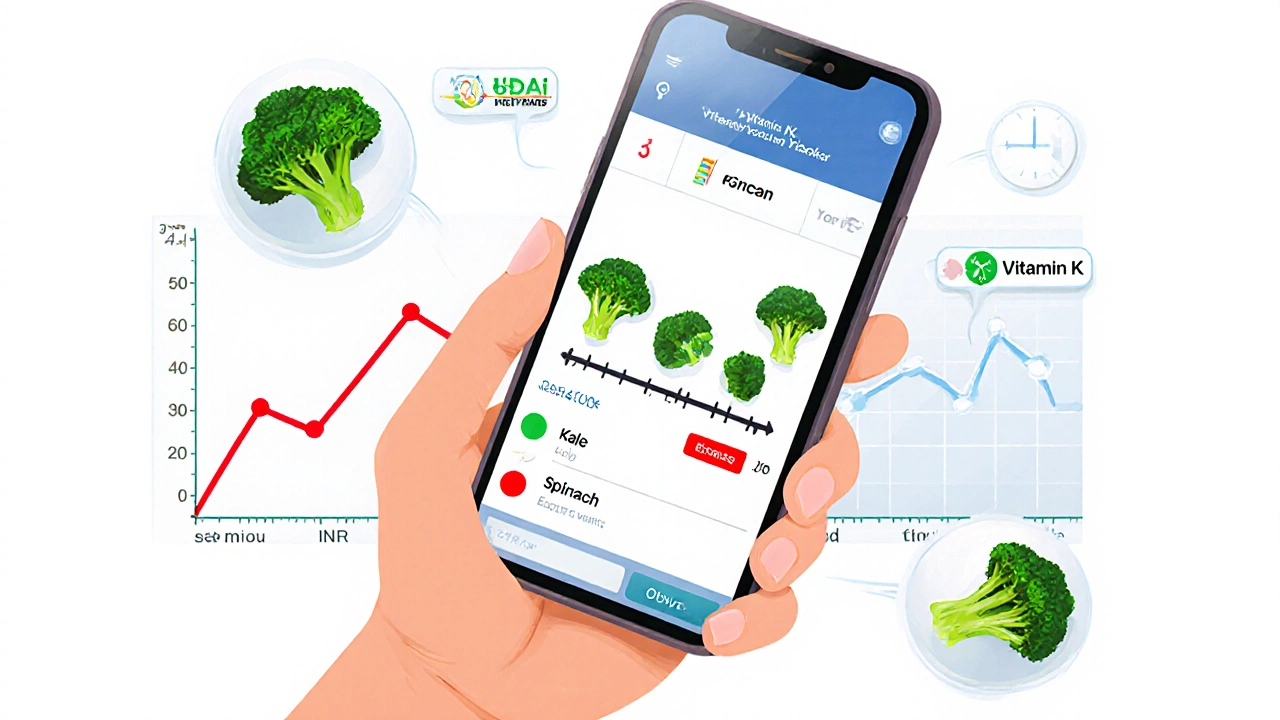
Since 2015, apps have taken over. The Vitamin K Counter & Tracker app (version 4.2.1, updated September 2023) is the most popular. It has over 1,200 foods with vitamin K values pulled straight from the USDA database. You scan a barcode, pick a portion size, and it calculates your intake instantly. It shows you a daily graph-green if you’re on track, red if you’ve gone over. No math. No guessing.A 2022 clinical trial tracked 327 warfarin patients for six months. Those using the app stayed in their target INR range 72.3% of the time. Paper users? Only 61.8%. That’s a 10.5% drop in dangerous INR swings. The app costs $2.99-one-time payment. No subscription. No ads. It’s built for this exact purpose.
But not all apps are equal. A 2023 study found 68% of vitamin K apps on the market have no clinical validation. Some guess values. Others mix up K1 and K2. The Vitamin K-iNutrient app stands out-it’s been lab-tested for accuracy and matches actual food analysis 94.7% of the time. Free apps? Don’t trust them. One study showed error rates over 30%.
What You Must Track
You don’t need to log every bite. Focus on the big players:- Leafy greens: kale, spinach, collards, Swiss chard
- Cruciferous veggies: broccoli, Brussels sprouts, cabbage
- Oils: soybean, canola, olive (olive has less, but still matters)
- Fortified foods: Ensure, Boost, meal replacement shakes
- Multivitamins: many contain 25-100 mcg of vitamin K
Even one multivitamin can shift your INR if you take it inconsistently. The key is timing. Take your vitamin and your warfarin at the same time every day. That way, if your vitamin K intake spikes, your body responds predictably.
Why People Underreport-And How to Fix It
Here’s the ugly truth: patients underreport vitamin K intake by 22-37%. Why? Because they don’t know what’s in processed foods. A frozen meal with soybean oil? A salad dressing made with canola? A granola bar with added vitamin K? They’re invisible unless you’re looking for them.One solution: use visual portion guides. The University of Iowa Hospitals and Clinics gave patients plastic measuring cups and spoons labeled with common foods. Those who used them cut portion errors by 41%. Another fix: do a 24-hour recall with your dietitian once a month. Compare what you wrote down to what you actually ate. You’ll be surprised how much you miss.
What the Experts Say
Dr. Gary Raskob, lead author of the 2021 American Society of Hematology guidelines, puts it bluntly: “The most important advice for patients on warfarin should be to maintain their usual dietary pattern.” Don’t go on a kale cleanse. Don’t suddenly stop eating spinach. Just keep it the same.Dr. Evan Stein from the University of Chicago adds: “Simply avoiding high-vitamin K foods is less effective than consistent consumption.” A patient who eats 150 mcg every day-whether it’s from spinach, broccoli, or a mix-has 18% fewer INR fluctuations than someone who swings between 50 mcg and 250 mcg.
The Agency for Healthcare Research and Quality found that using a food diary increases time in therapeutic range by over 8 percentage points. That’s not a small win. That’s the difference between a safe, stable life and repeated hospital visits.
Real Stories, Real Results
On Reddit’s r/Anticoagulants, one user wrote: “Using the Vitamin K Counter app cut my INR swings from monthly to quarterly. Tracking broccoli portions stopped my dose changing every two weeks.” That’s the kind of stability you want.Another user said: “Paper diary got soggy. Switched to app but hated typing everything in.” That’s the trade-off. Digital tools are better-but they require effort. If you’re not tech-savvy, ask your clinic for help. Many now offer one-on-one training.
What’s Coming Next
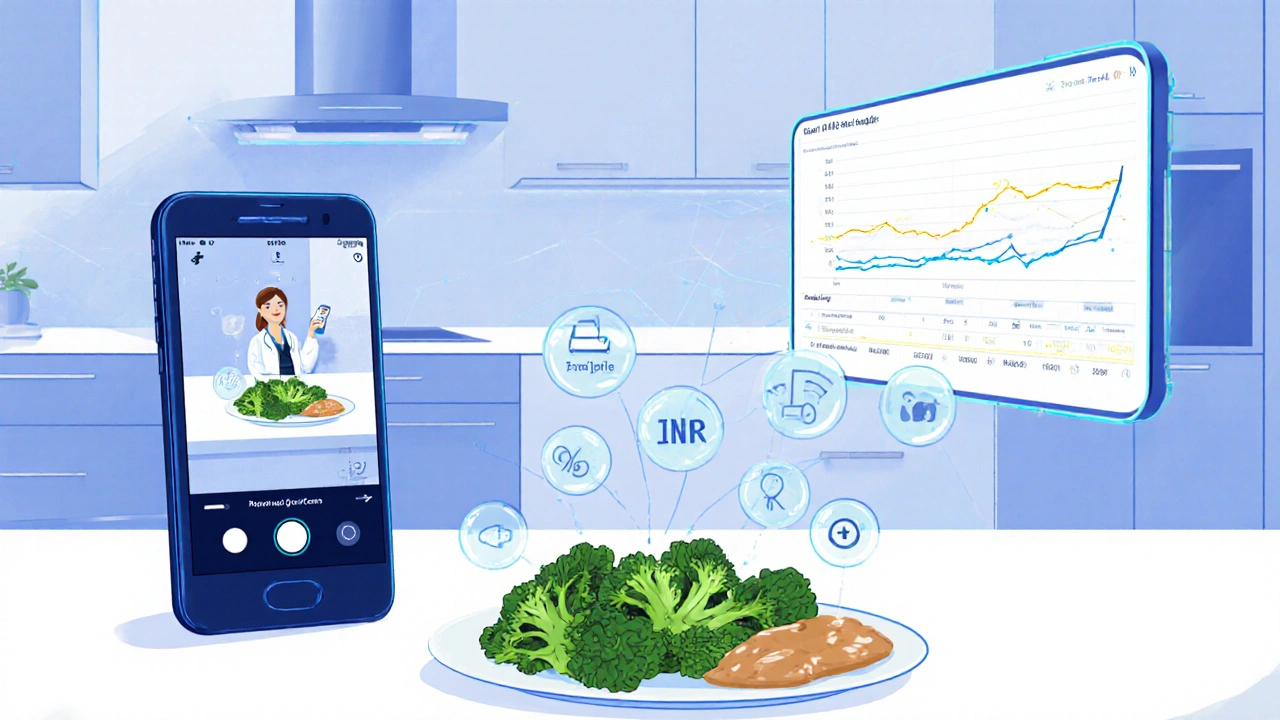
The future is smarter. In January 2024, the FDA approved NutriKare, an AI system that uses your phone’s camera to analyze food photos and estimate vitamin K content. It’s 89% accurate in trials. Epic Systems added vitamin K tracking to MyChart in 2023. Soon, your app will talk directly to your doctor’s system. Your INR will be predicted based on what you ate yesterday.The NIH is funding a $2.3 million study to see if real-time feedback improves outcomes. Results come out late 2024. One thing’s clear: food diaries aren’t going away. They’re getting better.
How to Start Today
1. Pick one method: app or paper. If you’re under 65, try Vitamin K Counter & Tracker. If you’re over 75, ask for a paper log from your clinic. 2. Track for 30 days. Don’t change your diet. Just record what you already eat. 3. Bring your diary to every INR check. Ask your provider: “Does this match my INR?” 4. Look for patterns. Are your INRs low after big salads? High after skipping greens? Adjust slowly. 5. Don’t quit. The first week is the hardest. After 30 days, it becomes routine.Warfarin isn’t a one-size-fits-all drug. It’s a dance between medicine and food. Your food diary is your partner. Keep it accurate. Keep it consistent. That’s how you stay safe.
Cris Ceceris
November 10, 2025 AT 00:43It’s wild how something as simple as broccoli can mess with your whole life. I used to think warfarin was just a pill you took and forgot about. Turns out, it’s like dating someone who needs consistency-skip a day of spinach and suddenly you’re in crisis mode. I started tracking with the Vitamin K app and honestly? My INR stopped acting like a rollercoaster. No more panic calls to the clinic. Just steady, quiet control. I didn’t even know oils had vitamin K until I scanned a salad dressing. Mind blown.
Erika Puhan
November 10, 2025 AT 07:48The data is statistically underwhelming. A 10.5% improvement in time-in-range is not clinically significant when the baseline adherence rate for paper logs is already 61.8%. The app’s cost-benefit ratio is negligible, especially when considering the cognitive load on elderly populations. Moreover, the USDA database referenced has known inaccuracies in K1/K2 differentiation-this is not evidence-based medicine, it’s tech-washing.
Edward Weaver
November 10, 2025 AT 15:10USA invented this stuff. Why are people still using paper? I mean, come on. We’ve got AI that can identify a potato from a drone. You can’t track kale with your phone? You’re not trying. And don’t get me started on those free apps-half of them were made by some guy in his basement in Bangalore. If you’re on warfarin, you owe it to yourself to use the best tool. Period. #AmericaFirst
Lexi Brinkley
November 11, 2025 AT 17:45OMG YES I switched to the app and my INR is SO MUCH BETTER 😍 I used to eat kale like it was candy and then panic when my number dropped. Now I just snap a pic and BOOM-green light! My mom still uses paper and she cried when hers got wet. Like… why?? 🤦♀️ #WarfarinLife #VitaminKAppIsLife
Kelsey Veg
November 13, 2025 AT 04:39the app is fine but i dont trust it. i mean how do u know its right? i read somewhere that the usda data is outdated and some of the numbers are just guesses. plus i keep forgetting to log. then i just make it up. lol. i think paper is more honest. even if i lose it.
Alex Harrison
November 13, 2025 AT 12:27Been using the app for 8 months. My INR has been stable as hell. I used to miss my multivitamin sometimes and it would mess me up. Now I log it every day-even the damn fish oil. I’m not perfect, I still miss a meal once in a while, but I’ve got the graph to remind me. Big thanks to the guy who made this app. No ads, no BS. Just straight-up science.
Jay Wallace
November 14, 2025 AT 12:49Let’s be clear: this is not ‘medicine.’ This is surveillance capitalism repackaged as healthcare. You’re being trained to monitor yourself with a $3 app while the system avoids investing in real care. And the FDA’s approval of NutriKare? A PR stunt. Real medicine is in the hands of clinicians-not algorithms trained on USDA spreadsheets. You’re not a data point. You’re a person. And you’re being exploited.
Alyssa Fisher
November 15, 2025 AT 10:54What’s fascinating to me is how this reflects a deeper truth about chronic disease management: stability beats perfection. It’s not about eating the ‘right’ amount of vitamin K-it’s about eating the same amount. That’s why consistency trumps restriction. We apply this logic in so many other areas-sleep, exercise, medication timing-but with diet, we still think ‘optimization’ is the goal. It’s not. It’s rhythm. It’s routine. And that’s why the diary works. Not because it’s high-tech. Because it’s human.
Alyssa Salazar
November 17, 2025 AT 04:25Y’all are underestimating the power of visual portion guides. I work in a clinic and we handed out those plastic measuring cups last year. Patients who used them? Their log accuracy jumped 40%. No app needed. Just a cup labeled ‘1/2 cup cooked spinach.’ I swear, if you can’t eyeball it, measure it. And yes, the app is great-but if you’re not tech-savvy, don’t force it. The goal isn’t to become a nutrition coder. It’s to stay alive.
Beth Banham
November 18, 2025 AT 17:28I’ve been on warfarin for 12 years. I use paper. I write in pencil. I keep it in my purse. I don’t like phones. I don’t like apps. I don’t care what the stats say. This works for me. My doctor knows my handwriting. I know my habits. I don’t need a graph to tell me I ate spinach last Tuesday. I remember. And I’m still here. That’s all that matters.
Brierly Davis
November 20, 2025 AT 13:08Just wanna say-you’re doing great. Seriously. If you’re reading this and you’re trying to track your food, you’re already winning. It’s not about being perfect. It’s about showing up. Even if you miss a day, just log it as ‘missed’ and keep going. I used to beat myself up over it. Now I just say, ‘Okay, next meal.’ You got this. 💪
Amber O'Sullivan
November 20, 2025 AT 14:32