Therapeutic Interchange: What Providers Really Do When Switching Medications Within the Same Class
 Dec, 30 2025
When a doctor prescribes a medication, patients often assume that’s the only option. But in hospitals, nursing homes, and other institutional settings, something else might be happening behind the scenes: therapeutic interchange. It’s not a random swap. It’s not a pharmacist guessing. And it definitely doesn’t mean switching from one drug class to another-like swapping a blood pressure pill for a diabetes drug. That would be dangerous. Therapeutic interchange is a carefully controlled process where a clinician replaces one medication with another in the same class because it’s just as effective, maybe cheaper, and fits better with the facility’s approved list of drugs.
It’s Not a Generic Swap-It’s a Strategic Move
People often confuse therapeutic interchange with generic substitution. They’re not the same. A generic swap is when you replace brand-name lisinopril with store-brand lisinopril. Same chemical. Same manufacturer, just cheaper packaging. Therapeutic interchange is different. It’s swapping lisinopril for enalapril-two different chemicals, both ACE inhibitors, both used for high blood pressure and heart failure. The goal isn’t just cost savings. It’s about aligning prescriptions with what the facility’s Pharmacy and Therapeutics (P&T) Committee has already vetted as safe, effective, and cost-efficient.These committees aren’t made up of pharmacists alone. They include doctors, nurses, pharmacists, and sometimes even patient advocates. They review clinical studies, side effect profiles, and real-world outcomes. If two drugs in the same class have similar results but one costs $30 a month and the other $120, the committee might recommend the cheaper one as the default-unless there’s a clear reason not to.
Why Do Providers Do This?
The main reason? Cost control without sacrificing care. In a skilled nursing facility with 200 residents, a single medication change can save thousands each month. SRX Technologies found some long-term care centers cut pharmacy bills by tens of thousands monthly just by sticking to their formulary. That money doesn’t vanish-it goes back into staffing, therapy services, or better food. In hospitals, it helps standardize treatment. If everyone uses the same few drugs in each class, it’s easier to track outcomes, spot side effects early, and train staff.But it’s not just about saving money. Sometimes, one drug in a class works better for certain patients. Maybe a patient has kidney issues, and one ACE inhibitor is cleared more safely than another. Or maybe one has fewer interactions with other meds they’re taking. The P&T Committee builds exceptions into the rules. The goal isn’t to force everyone onto one drug. It’s to make the most common, safest, most affordable option the starting point-and allow flexibility when needed.
How It Actually Works (Step by Step)
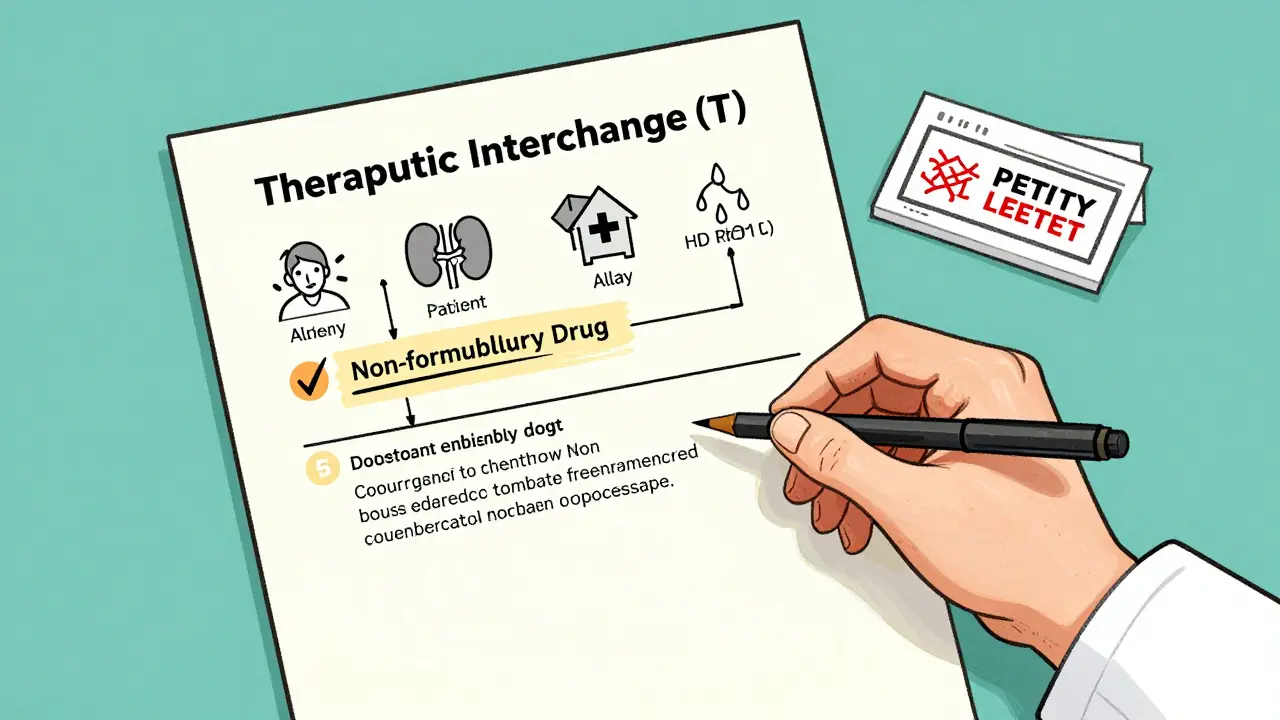
Here’s how therapeutic interchange plays out in a real hospital or nursing home:- A doctor writes a prescription for a drug that’s not on the facility’s preferred list.
- The pharmacist flags it and checks the formulary. They see that a similar drug in the same class is approved.
- The pharmacist doesn’t just swap it. They check the patient’s history. Are there allergies? Previous bad reactions? Other meds that might clash?
- If it’s safe and fits the criteria, they contact the prescriber. In many places, they need written permission-called a Therapeutic Interchange (TI) Letter-signed by the doctor before making the switch.
- Once approved, the pharmacy dispenses the alternative drug going forward. If the doctor prescribes the original drug again, the pharmacy automatically substitutes it, because the permission is already on file.
This system only works because of documentation. Without a signed TI letter, most facilities can’t legally switch. That’s why it’s rare in community pharmacies. A retail pharmacist can’t call a patient’s doctor every time a brand-name drug is prescribed. It’s too slow. So in those settings, generic substitution is the norm. Therapeutic interchange needs structure-and structure takes time.
State Laws Make a Big Difference
You can’t talk about therapeutic interchange without talking about state laws. In some states, pharmacists have broad authority to make substitutions under a pre-approved formulary. In others, every single change requires direct prescriber approval-even if the drug is on the approved list. Vanderholm’s 2018 research showed this variation is widespread. One state might allow a global TI letter covering all patients in a nursing home. Another might require a new signature every time a different patient gets switched.This inconsistency creates headaches for providers who work across state lines. A pharmacist in California might be used to swapping drugs automatically. In Texas, they’d have to call every time. That’s why large healthcare systems train staff on local rules before moving them between locations.
What Happens When It Goes Wrong?
The biggest risk? Making a swap that doesn’t fit the patient. Maybe the patient had a bad reaction to the alternative drug years ago. Maybe they’re on a specific brand because it’s the only one that works for their rare condition. Or maybe the prescriber didn’t fully understand the difference between the two drugs.Experts are clear: therapeutic interchange should only happen when the two drugs are expected to have substantially equivalent therapeutic effect. That’s not a vague phrase. It means clinical trials, real-world data, and expert consensus must support the swap. The American College of Clinical Pharmacy says it outright: no switching across classes. No swapping a beta-blocker for a calcium channel blocker just because they both lower blood pressure. The mechanisms are different. The side effects are different. The risks are different.
When done right, therapeutic interchange improves care. When done carelessly, it can cause harm. That’s why the process is so tightly controlled. It’s not a shortcut. It’s a safety net.

Why It Doesn’t Work in Retail Pharmacies
You won’t see therapeutic interchange at your local CVS or Walgreens-and here’s why. Retail pharmacies don’t have formularies like hospitals do. They fill prescriptions as written. They don’t have a P&T Committee reviewing every drug choice. And they don’t have the time to call every doctor for permission.Plus, patients expect to get what their doctor ordered. If you walk in with a prescription for Lipitor and the pharmacist hands you Crestor, you might walk out angry-or worse, confused. In institutional settings, patients are often less involved in daily medication decisions. They’re cared for by teams. Communication is built into the workflow. In retail, that infrastructure doesn’t exist.
That’s why pharmacists in community settings stick to generics. If a brand-name drug is prescribed, they can only substitute if it’s FDA-approved as interchangeable-and even then, they have to tell the patient and let them say no.
What Patients Should Know
If you’re in a hospital or nursing home and your medication changes, don’t panic. Ask: Is this a generic swap, or are they switching to a different drug in the same class? If it’s the latter, ask why. Was it for cost? For fewer side effects? Did your doctor approve it?Most of the time, the change is safe-and even helpful. But you have a right to know. If you’re unsure, ask your pharmacist or nurse to explain the difference between the old and new drug. If you’ve had problems with similar medications before, speak up. Therapeutic interchange works best when patients are part of the conversation.
The Bigger Picture
Therapeutic interchange isn’t a new idea. It’s been used in over 80% of U.S. hospitals since 2002. It’s not going away. With drug prices still rising-8% increases were projected as recently as 2018-it’s one of the few tools healthcare systems have to manage costs without cutting care.But its success depends on three things: strong formularies built by teams of experts, clear communication between prescribers and pharmacists, and respect for individual patient needs. It’s not about cutting corners. It’s about making smarter choices. And when done right, it helps more people get the care they need-without breaking the bank.
Aayush Khandelwal
January 1, 2026 AT 05:57Therapeutic interchange is the unsung hero of institutional pharmacy - it’s not just cost-cutting, it’s clinical optimization with paperwork. You swap lisinopril for enalapril not because you’re lazy, but because the P&T committee ran 14 meta-analyses and found the latter has 22% fewer GI side effects in geriatric cohorts. This isn’t generic substitution - it’s pharmacoeconomic ballet. And yeah, the TI letter? That’s the legal spine holding the whole system upright. No shortcuts. No guesswork. Just evidence, bureaucracy, and a whole lot of coffee-stained formularies.
Sandeep Mishra
January 2, 2026 AT 10:26It’s beautiful, really - a system where science, cost, and human care try to dance together. 🤝 I’ve seen patients who couldn’t afford their meds before, now stabilized on a cheaper alternative that *actually* worked better for their kidneys. The key isn’t the drug - it’s the listening. The pharmacist checking history. The doctor signing off. The patient being told, not just swapped. That’s healthcare with a soul. Not perfect, but trying. And that’s more than most systems manage.
Hayley Ash
January 3, 2026 AT 16:36So let me get this straight - you’re telling me pharmacists are now the de facto prescribing authorities in nursing homes? Cool. So next they’ll be writing scripts for antidepressants and insulin too? Just swap the whole damn formulary until we’re all on generic morphine and vitamin D. At least in retail, the doctor’s name is on the damn prescription. Here? It’s like a game of telephone with a 200-page formulary and zero accountability. Oh and don’t forget - the ‘P&T Committee’ is just a bunch of hospital admins who think ‘equivalent’ means ‘close enough’
kelly tracy
January 4, 2026 AT 06:17This is how healthcare gets destroyed. You let bureaucrats decide what drugs patients get. Not doctors. Not patients. Not even pharmacists with real clinical training - just some committee that picked the cheapest option because it’s ‘on formulary.’ And you call this ‘care’? When my grandma got switched from her stable brand-name drug to a generic equivalent that made her hallucinate, no one cared. Because the formulary said it was ‘therapeutically equivalent.’ Equivalency my ass. People are not lab rats. This is corporate medicine at its most monstrous.
Cheyenne Sims
January 4, 2026 AT 13:17Therapeutic interchange is a legally and clinically sound practice when executed under strict regulatory oversight and with documented clinical justification. The distinction between generic substitution and therapeutic interchange is not merely semantic-it is foundational to pharmacovigilance. The referenced P&T committees operate under ASHP guidelines, and the TI letter requirement is codified in state pharmacy acts. To conflate this with cost-driven rationing is both factually inaccurate and ethically irresponsible. The system is designed to prevent harm, not enable it.
Glendon Cone
January 4, 2026 AT 21:37Just had a nurse explain this to me last week at my dad’s rehab center. They switched his blood pressure med from lisinopril to benazepril - same class, cheaper, same results. He didn’t even notice. But they sat down with him, showed him the chart, explained why, and asked if he’d had issues with either before. That’s the difference. It’s not about saving money - it’s about saving *time* for the team so they can actually talk to patients. 🤖➡️👨⚕️
Henry Ward
January 6, 2026 AT 08:26Of course it’s safe - until it’s not. You think these committees actually read the studies? Or do they just pick the drug with the highest rebate from the pharma rep? I’ve seen patients on a stable regimen get switched because the new drug had a 15% discount. Then they end up in the ER with dizziness, falls, confusion - and suddenly it’s ‘patient noncompliance.’ Wake up. This isn’t clinical decision-making. It’s supply chain arbitrage dressed up as medicine.
Joseph Corry
January 6, 2026 AT 23:41Therapeutic interchange reveals the ontological crisis of modern healthcare: the reduction of the patient to a data point within a formulary matrix. One is no longer a unique bio-psycho-spiritual entity, but a variable in a cost-effectiveness algorithm. The P&T committee, in its bureaucratic wisdom, seeks to homogenize therapeutic outcomes - yet in doing so, it erases the very phenomenology of illness. Is a drug ‘equivalent’ if the soul of the patient recoils? The answer, of course, is buried in the fine print of the TI letter.
Colin L
January 7, 2026 AT 15:24Look, I’ve worked in three different states and I’ve seen this play out every single time - in California, pharmacists can swap anything on the formulary without a signature as long as it’s a tier-1 drug, but in New York, you need a notarized affidavit from the prescriber, the patient’s next of kin, and a notarized statement from the patient’s cat’s veterinarian, just to switch from metoprolol succinate to metoprolol tartrate - and don’t even get me started on how Texas requires a new TI letter for every single patient, even if they’re in the same nursing home and have been on the same drug for five years and the only difference is their room number - which is ridiculous because the drug doesn’t care what room they’re in, it’s not like the pill knows the difference between Room 214 and Room 215 - and I’ve seen patients get stuck on expensive brand-name meds for weeks because the nurse forgot to fax the TI letter and the pharmacist won’t touch it without it even though the doctor approved it three days ago and the formulary says it’s fine - and this is why we have medication errors - not because people are bad, but because the system is designed by someone who hates humans and wants to make everything as slow and painful as possible - and yes I’ve cried over a TI letter before - I’m not ashamed to say it - I cried because I knew the patient was going to be discharged in two days and we still hadn’t gotten the approval and I had to call the doctor at 2 a.m. and he was drunk and said ‘just give them the other one’ and I said ‘I can’t legally’ and he said ‘well I’m not coming in’ and I had to call the pharmacy director and she said ‘well I guess we’ll just wait’ and I just sat there holding the prescription and wondering if the patient would have a stroke because we didn’t switch the med and I thought about quitting medicine and then I thought about how my mom had a stroke from a bad med switch and I just cried harder and now I’m typing this at 3:17 a.m. and I don’t even know why I’m sharing this but I needed to say it out loud because nobody listens and nobody cares and the formulary doesn’t care and the committee doesn’t care and the pharmacy doesn’t care and the patient doesn’t know and I’m just tired
srishti Jain
January 9, 2026 AT 09:03They swap meds. Patients die. Who cares. Formulary wins.