Team-Based Care: How Multidisciplinary Teams Improve Generic Prescribing Outcomes
 Jan, 28 2026
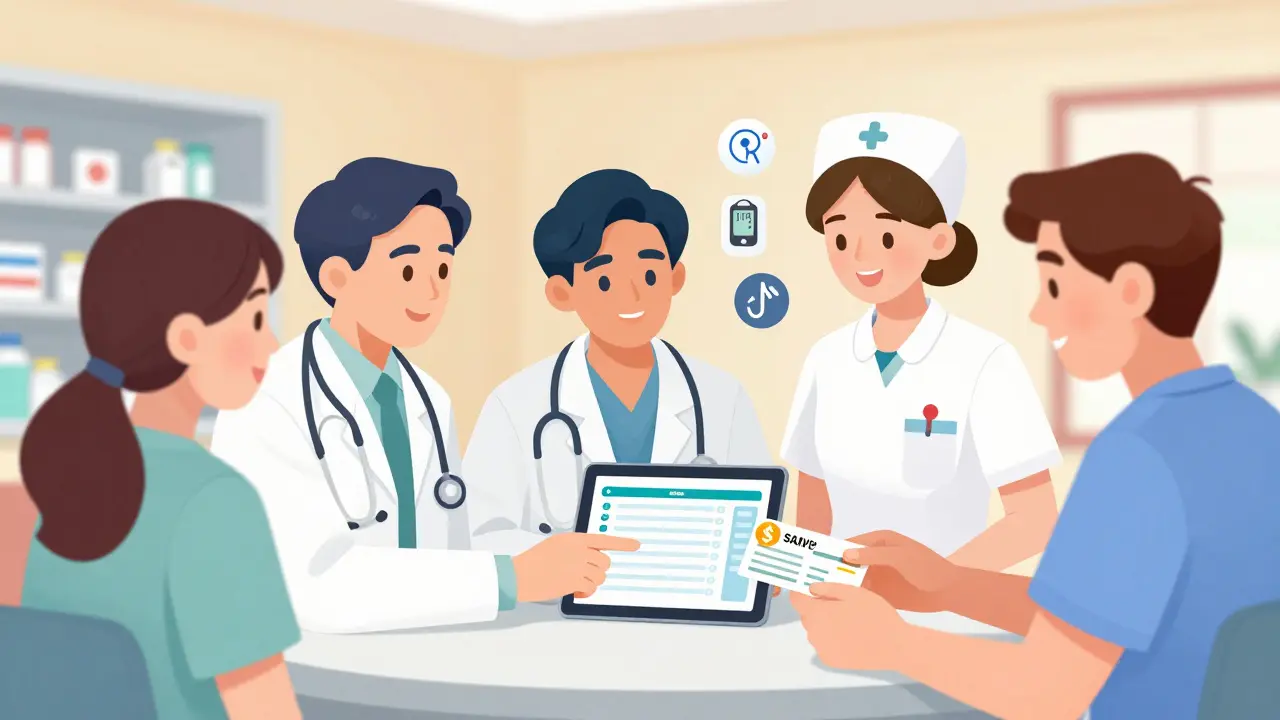
When you walk into a doctor’s office for a routine checkup, you might think your medication list is just between you and your physician. But in reality, a quiet team of professionals-pharmacists, nurses, care coordinators, and sometimes even tech tools-are already working behind the scenes to make sure those prescriptions are safe, effective, and affordable. This isn’t science fiction. It’s team-based care, and it’s changing how generic drugs are prescribed across the U.S.
What Team-Based Care Really Means for Medications
Team-based care isn’t just a buzzword. It’s a structured system where different healthcare providers share responsibility for your health, especially when it comes to managing medications. The National Academy of Medicine defined it clearly in 2017: it’s about multiple professionals working together with patients and families to reach shared goals. In the context of prescribing, that means no one person is making all the calls.Doctors still handle complex diagnoses and treatment plans, but pharmacists now play a central role in reviewing every medication you take. Nurses monitor your blood pressure, blood sugar, or kidney function. Care coordinators make sure you don’t get conflicting prescriptions from three different specialists. And together, they focus on one big question: Is this the right drug, at the right dose, for the right reason-and can we make it cheaper without losing effectiveness?
Why Generic Substitution Isn’t Just About Saving Money
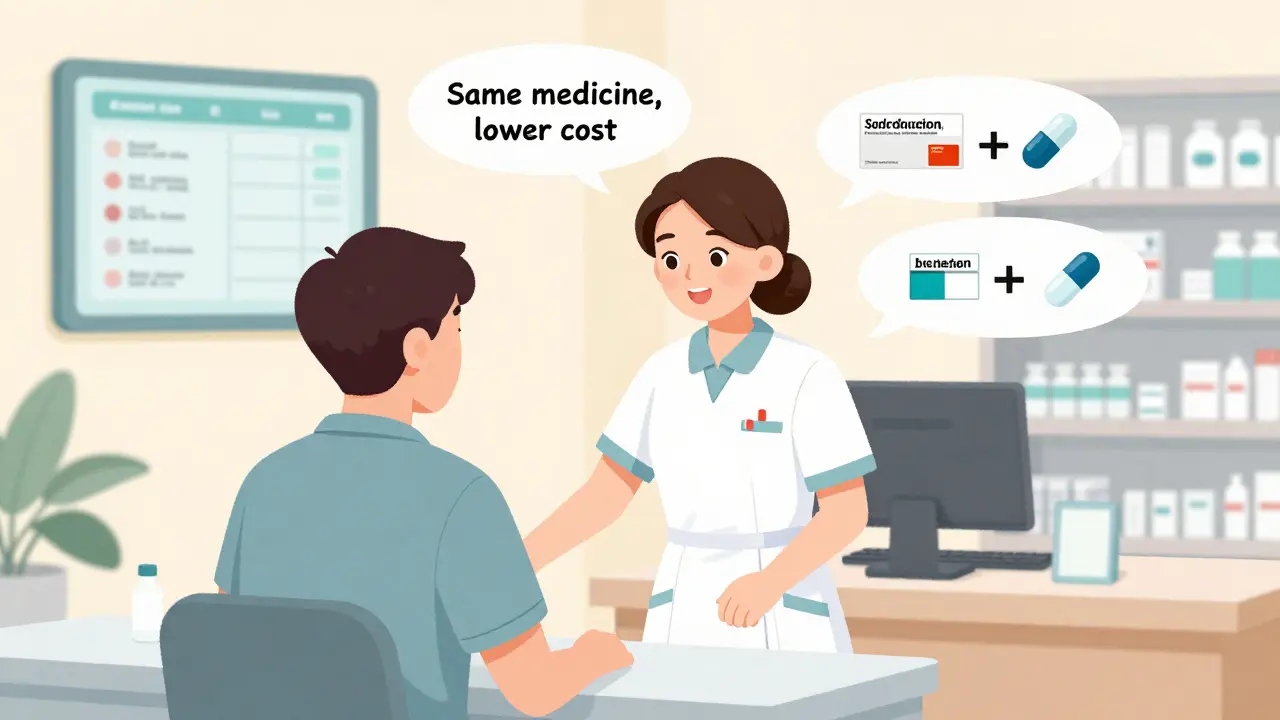
Many patients assume switching to a generic drug is just a cost-cutting move. But in team-based care, it’s a clinical decision. Generic drugs are bioequivalent to brand-name versions-they contain the same active ingredient, work the same way, and meet the same FDA safety standards. Yet, studies show that without proper guidance, patients often refuse generics because they’re afraid they’re “weaker” or “inferior.”That’s where pharmacists come in. According to the American Pharmacists Association, when pharmacists are embedded in care teams, they improve patient adherence to generics by 28%. Why? Because they don’t just swap pills-they explain why the switch is safe. A patient with high blood pressure might get a generic lisinopril instead of the brand-name version, saving $200 a month. But if the pharmacist takes five minutes to walk them through the science, the patient is far more likely to stick with it.
And the savings aren’t just personal. A 2023 analysis by PureView Health Center found that team-based medication management saves $1,200 to $1,800 per patient annually-mostly through smart generic substitutions and avoiding hospital readmissions caused by medication errors.
The Roles: Who Does What in the Team
Think of the team like a well-rehearsed orchestra. Each player has a defined part:- Physicians: Diagnose conditions, set treatment goals, approve final prescriptions. They focus on complex cases-like patients with five or more chronic conditions.
- Pharmacists: Conduct comprehensive medication reviews. They flag drug interactions, duplicate therapies, and recommend generics. They’re trained to identify when a brand-name drug isn’t necessary.
- Nurses and Medical Assistants: Monitor vital signs, track adherence, educate patients on how to take meds correctly. They often do “co-visits,” where they meet with patients before the doctor arrives to gather data and answer basic questions.
- Care Coordinators: Act as the glue. They make sure specialists and primary care providers are on the same page. They update electronic records, schedule follow-ups, and help patients navigate insurance hurdles for generic alternatives.
One of the most effective practices? The “warm handoff.” Instead of handing a patient a paper script and saying, “See your pharmacist,” the nurse walks them to the pharmacist’s station right in the clinic. That simple step, documented in a 2022 case study at SICHC, led to 42% more patients accepting generic switches-because trust was built in the moment.
How It Works in Real Life: A Patient’s Journey
Meet Maria, 68, with hypertension, type 2 diabetes, and high cholesterol. She takes seven medications. Her old doctor prescribed everything without checking for interactions or cost. She was spending over $600 a month on pills.After switching to a clinic with team-based care, here’s what changed:
- Her pharmacist reviewed all her meds and found two duplicates-one for cholesterol, one for blood pressure-that were both brand-name.
- The pharmacist recommended switching both to generics, saving her $350/month.
- A nurse noticed her blood pressure wasn’t improving and flagged that she wasn’t taking her diuretic because it made her wake up to pee at night.
- The care coordinator arranged a telehealth visit with the doctor to adjust the timing of her dose.
- Within three months, her blood pressure dropped, her A1C improved, and her out-of-pocket costs fell to $250/month.
This isn’t rare. On Healthgrades, practices using team-based care average 4.7 out of 5 stars. One patient wrote: “The pharmacist caught three interactions my doctor missed and switched me to generics that saved me $200 monthly.”
The Hidden Challenges
It’s not all smooth sailing. Many doctors still feel uncomfortable handing off medication decisions. One physician on Doximity reported that after implementing team-based care, his administrative time jumped by 2.5 hours a week-until workflows were fixed.Initial setup costs are steep. The VA found it takes $85,000 to $120,000 per practice to train staff, update electronic records, and build collaborative practice agreements (CPAs). Smaller clinics struggle with this. And if documentation is sloppy, liability risks rise by nearly 20%.
Another issue: communication breakdowns. The Commonwealth Fund found that 12% of negative reviews mentioned “confusing messages” between team members. Maybe the pharmacist recommends a generic, but the doctor’s note doesn’t reflect it. Or the nurse forgets to update the chart after a patient refuses a switch. These gaps can lead to medication errors.
And while pharmacists are trained experts, a 2021 study in the Journal of General Internal Medicine found that 5.2% of medication recommendations from non-physician team members had potential risks in complex patients. That’s why oversight still matters. Trust isn’t blind-it’s built through clear protocols, shared goals, and mutual respect.
What’s Changing Right Now
The system is evolving fast. In 2023, Medicare Part D lowered the eligibility bar for Medication Therapy Management (MTM) services from five to four chronic medications. That means over 4 million more people will now qualify for team-based medication reviews.Telepharmacy is booming. Between 2020 and 2023, virtual pharmacy services grew by 214%. That’s huge for rural areas where pharmacists are scarce. Now, a patient in Appalachia can have their meds reviewed by a pharmacist in Asheville via video call.
Even AI is getting involved. Mayo Clinic’s pilot program uses algorithms to suggest generic alternatives based on a patient’s history, insurance formulary, and clinical guidelines. The result? 22% more appropriate generic use and a 9.3% drop in adverse events.
Where It Works Best-and Where It Doesn’t
Team-based care shines with chronic conditions: diabetes, heart failure, asthma, high blood pressure, and high cholesterol. These are long-term diseases where small tweaks in medication can prevent big problems like strokes or kidney failure.But it’s less useful in emergencies. If someone comes in with chest pain, you don’t wait for a team huddle. You act fast. That’s where traditional, physician-led care still makes sense.
It also works best in settings where teams are already integrated: VA hospitals, large health systems, and clinics tied to Medicare Advantage plans. These places have the resources to train staff, update tech, and get reimbursed.
Small private practices? They’re catching on slowly. Only 32% have adopted the model-mostly through accountable care organizations that tie payments to outcomes, not volume.
The Bottom Line
Team-based care isn’t about replacing doctors. It’s about supporting them-with better tools, smarter分工, and more eyes on the medication list. Generic prescribing isn’t just a cost-saving trick. It’s a clinical opportunity-and when done right, it saves lives, reduces hospital stays, and makes care more human.Patients aren’t asking for fancy new drugs. They’re asking for simpler, safer, and cheaper ways to stay healthy. Team-based care answers that call-not with one person, but with a whole team working together.
Can pharmacists really prescribe medications?
In many states, pharmacists can prescribe under collaborative practice agreements (CPAs) with physicians. These agreements allow pharmacists to adjust doses, start or stop medications, and switch to generics for conditions like hypertension, diabetes, and high cholesterol-especially in team-based settings. They can’t diagnose new conditions, but they can manage existing ones under protocol.
Why don’t all doctors use team-based care?
Some fear losing control over patient care. Others don’t have the time or money to restructure workflows. Training staff, updating electronic records, and setting up communication systems takes months and thousands of dollars. Smaller practices often lack the resources, and reimbursement for team-based services is still inconsistent-only 41% of these services are fully paid for by insurers.
Are generic drugs really as good as brand-name ones?
Yes. The FDA requires generics to have the same active ingredient, strength, dosage form, and route of administration as the brand-name version. They must also meet the same strict standards for purity and performance. The only differences are in inactive ingredients like fillers or dyes-which rarely affect how the drug works. Most patients see no difference in effectiveness.
How do I know if my clinic uses team-based care?
Look for signs: Is there a pharmacist on-site? Do nurses check your vitals before you see the doctor? Do you get a medication review after each visit? Ask directly: “Do you have a team that reviews all my medications together?” If they say yes-and can explain how it works-you’re likely in a team-based model.
Will my insurance cover team-based medication services?
If you’re on Medicare Part D, you’re already eligible for free Medication Therapy Management (MTM) if you take four or more chronic disease medications and spend over $4,000 a year on them. Many Medicare Advantage plans offer similar services. Private insurers vary, but most now cover pharmacist consultations if they’re part of a structured care team. Always ask your plan about MTM or “comprehensive medication management.”
rajaneesh s rajan
January 30, 2026 AT 08:21So let me get this straight - we’re paying doctors to stare at screens while pharmacists do the actual work? 🤔 I’m not mad, I’m just impressed. The real MVPs are the ones who know what’s in the pills, not just what’s on the clipboard.
DHARMAN CHELLANI
January 30, 2026 AT 13:42generic = weak. brand = strong. duh. why do u think they charge more? lol. its called profit. not science. also pharma owns the system. 🤡
kabir das
January 31, 2026 AT 21:02Wait… wait… wait… so you’re telling me… that… a… pharmacist… can… actually… help… me… not… die… from… my… own… meds…?!?!?!?!
Keith Oliver
February 1, 2026 AT 04:54Look, I’ve worked at Johns Hopkins and let me tell you - if your clinic doesn’t have a clinical pharmacist embedded in the EHR with real-time decision support, you’re operating in the Stone Age. Also, why are we even talking about this like it’s novel? It’s been standard in the UK since 2012.
Kacey Yates
February 3, 2026 AT 00:15My mom got her blood pressure meds switched to generic and her kidney numbers improved. The nurse noticed she wasn't taking them because the pills looked different. They changed the pill color. Simple. Effective. No drama. Why is this hard?
Jasneet Minhas
February 4, 2026 AT 06:25Team-based care = the healthcare version of a well-coordinated soccer team. 🏆 One player can't win it all. But when everyone passes, moves, and communicates? Magic happens. 🙌 Also, generics are not 'cheap drugs' - they're smart drugs. 💡
Kristie Horst
February 6, 2026 AT 03:58It is profoundly disheartening to observe that, despite overwhelming evidence supporting multidisciplinary medication management, systemic inertia persists due to entrenched hierarchies and reimbursement misalignments. The human cost is incalculable.
Andy Steenberge
February 6, 2026 AT 19:34My cousin in rural Iowa got her diabetes meds reviewed by a telepharmacist during a Zoom call. She didn’t even have to drive 45 minutes. That’s not innovation - that’s basic dignity. We’re just now catching up to what other countries do daily.
Laia Freeman
February 6, 2026 AT 19:53OMG I just realized my clinic DOES this!! The pharmacist asked me if I could afford my meds and switched me to generics and now I’m not choosing between insulin and groceries!! Thank you thank you thank you!! 😭❤️
paul walker
February 8, 2026 AT 07:45My doc tried to hand me a script and said 'see your pharmacist' and I just walked out. Now I know why. They need to actually talk to each other. Like, in the same room. With words.
Alex Flores Gomez
February 8, 2026 AT 08:44AI suggesting generics? Bro, that’s just Big Pharma’s way of automating the scam. You think they care about your kidneys? Nah. They care about their stock price. And you’re just a data point.
Frank Declemij
February 8, 2026 AT 20:47This model works. I’ve seen it. The data is clear. The only barrier is bureaucracy. Fix the billing codes and the rest follows.
Pawan Kumar
February 9, 2026 AT 18:24Are we sure this isn’t just a stealth government takeover of medicine? Pharmacists prescribing? Nurses making clinical calls? Who’s really controlling the charts? And why does the VA get all the resources while the rest of us struggle?
ryan Sifontes
February 11, 2026 AT 05:26Team-based care. Right. And I’m sure the paperwork to get one pharmacist hired is only 17 forms and 3 years of waiting. Meanwhile, my mom’s on 12 meds and nobody’s even checking if they interact. Classic.