Shared Decision-Making Scripts for Side Effect Trade-Offs in Medication Choices
 Jan, 23 2026
Side Effect Trade-Off Calculator
How your values impact treatment choices
Most patients stop medication due to side effects they can't live with. This tool helps you identify which side effects matter most to you before your next appointment.
Side Effect Comparison
Absolute numbers help you understand real risks (e.g., 15 out of 100 people get nausea)
Your Personalized Recommendation
Based on your priorities, this treatment may not be ideal. Consider discussing alternative options with your doctor.
Pro tip: Share this result with your doctor. It shows exactly which side effects matter most to you.
When you’re deciding whether to start a new medication, the biggest worry isn’t always whether it works-it’s what it might do to you. Nausea. Fatigue. Weight gain. Dizziness. These aren’t just side effects listed in tiny print. They’re real, daily disruptions to your life. And if your doctor doesn’t talk to you about them in a way that makes sense, you might end up stopping the medicine altogether-even if it’s helping you live longer or feel better.
Why Side Effect Trade-Offs Matter More Than You Think
Eighty-six percent of people taking statins quit because they’re afraid of muscle pain or fatigue. Three to five percent of those on blood thinners will have a major bleed in a year. These aren’t rare events. They’re common enough that every decision about medication should include a real conversation-not just a checklist.
Traditional informed consent often sounds like this: “This drug has side effects. Take it or don’t.” But that’s not enough. Patients need to know which side effects matter most to them. One person might accept occasional dizziness if it means avoiding a stroke. Another might refuse a drug that causes even mild nausea because they work as a truck driver. That’s where shared decision-making scripts come in.
The SHARE Approach: A Step-by-Step Framework
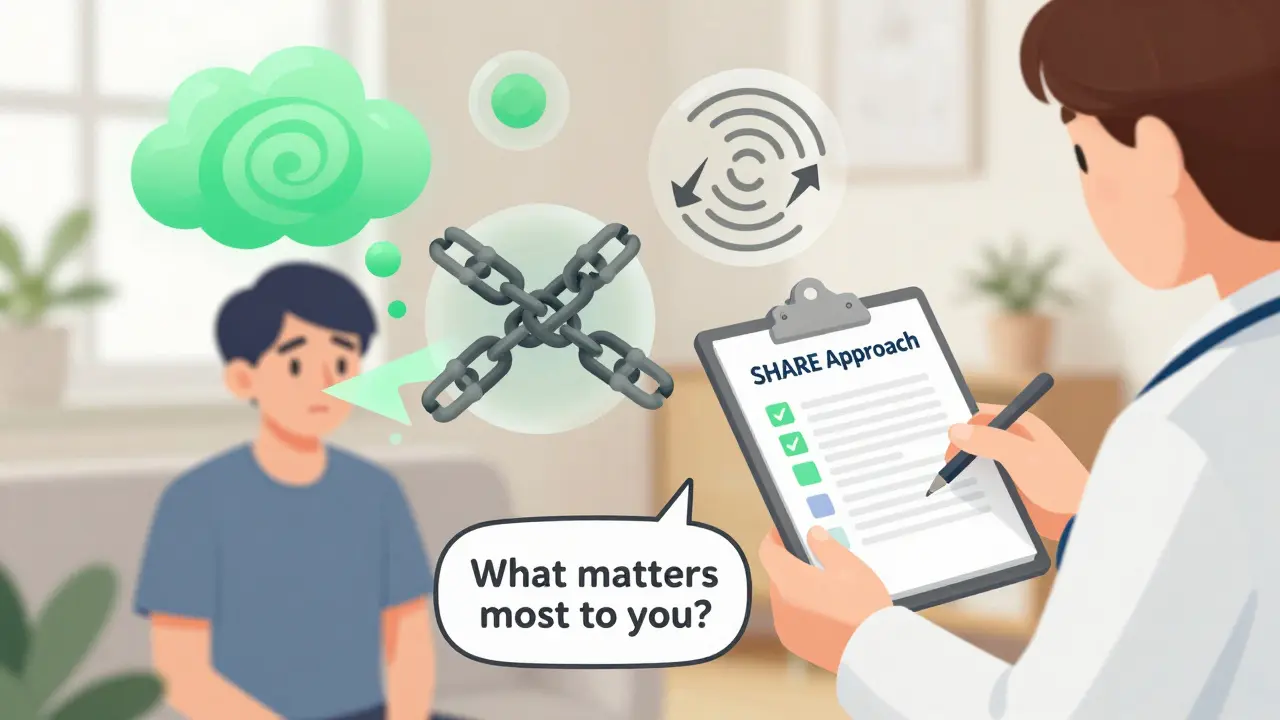
The Agency for Healthcare Research and Quality (AHRQ) developed the SHARE Approach to make these conversations easier. It’s not a script you memorize-it’s a structure you follow. Here’s how it works:
- Seek opportunities to involve the patient. Don’t assume they want to decide. Ask: “Would you like to be part of choosing your treatment?”
- Help explore options. Don’t just say, “Here’s the drug.” Say: “We have three choices: Drug A reduces your risk of heart attack by 20%, but 1 in 10 people get stomach upset. Drug B works just as well but causes dry mouth in 1 in 4. Option C is lifestyle changes alone.”
- Assess values. This is the key. Ask: “What side effects would make you say no to this treatment?” Or: “Some people are okay with fatigue if their cholesterol drops. Others can’t work if they’re tired. Where do you stand?”
- Reach a decision together. Don’t push. Don’t rush. Say: “Based on what you’ve said, it sounds like avoiding dizziness is more important than the extra 5% protection. Is that right?”
- Evaluate later. Check in after a few weeks: “How’s the medication working for you? Any surprises?”
This isn’t theory. In a 2021 study published in the Journal of General Internal Medicine, patients who used this approach had 23% less decision regret. They were more likely to stick with their treatment-and less likely to blame their doctor when side effects happened.
The Three-Talk Model: How to Talk About Numbers
Doctors often say things like “This side effect is rare” or “Most people tolerate it fine.” But those words mean nothing. One person’s “rare” is another’s nightmare.
The three-talk model, used by oncologists and endorsed by NICE guidelines, forces clarity:
- Option talk: “Here are your choices.”
- Option comparison: “Here’s what happens with each.”
- Decision talk: “What matters most to you?”
When discussing side effects, use absolute numbers-not percentages that sound impressive. Say: “Out of 100 people who take this drug, 15 will get nausea. That means 85 won’t.” Not: “Nausea occurs in 15% of patients.” The difference? People remember the 85 who didn’t have it. They feel less scared.
Studies in the Annals of Internal Medicine show patients understand risk 37% better when numbers are framed this way. That’s not a small win. It’s the difference between starting a medication and walking away.
What Patients Really Say About Side Effect Conversations
On Reddit, a thread titled “How my doctor helped me choose between medications with difficult side effects” got over 140 upvotes. People weren’t thanking their doctor for prescribing the right drug. They were thanking them for asking:
- “She asked which side effect would ruin my week. I said dizziness. She crossed out two options right away.”
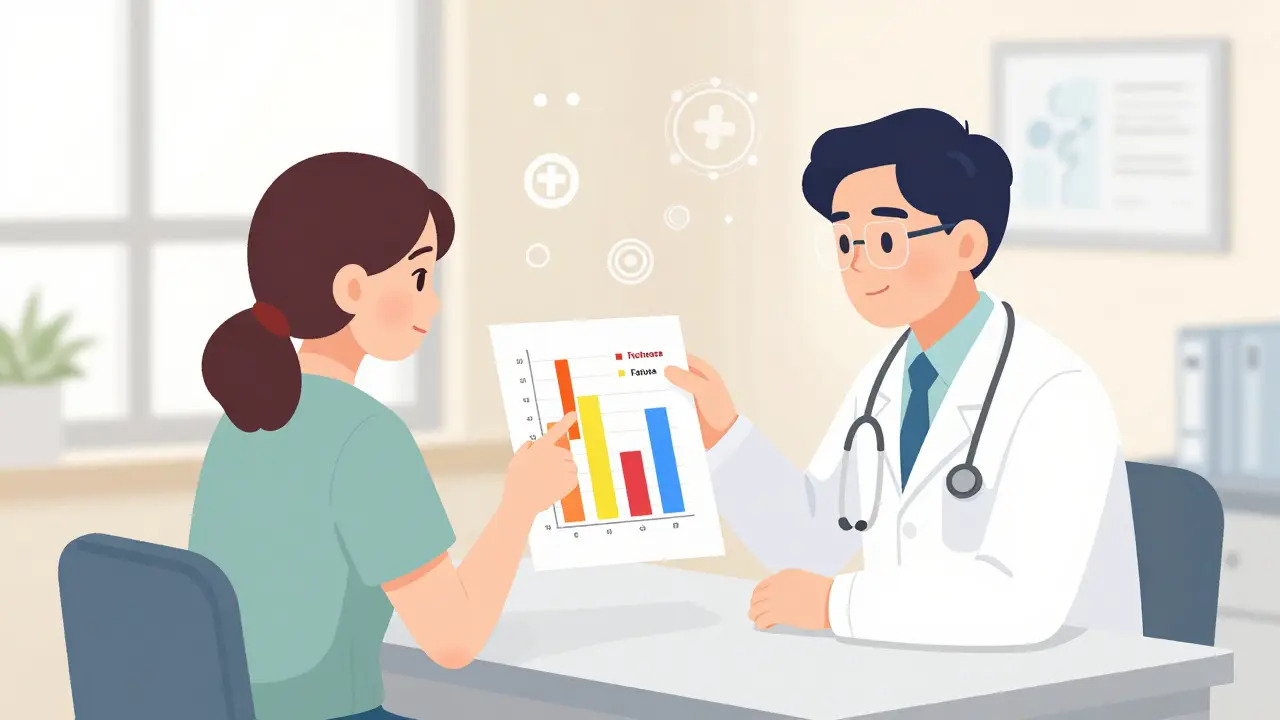
- “He showed me a chart with colored bars-red for nausea, yellow for fatigue. I saw mine was mostly yellow. That’s when I knew.”
- “No one ever asked me if I’d rather be a little tired than risk a stroke. That’s the first time someone listened.”
A 2022 survey by the Informed Medical Decisions Foundation found 84% of patients felt more confident in their choice when doctors used structured methods. But 63% said they felt dismissed when doctors just read from a script without adapting to their real concerns.
It’s not about the script. It’s about the conversation.
What Doesn’t Work: When Scripts Backfire
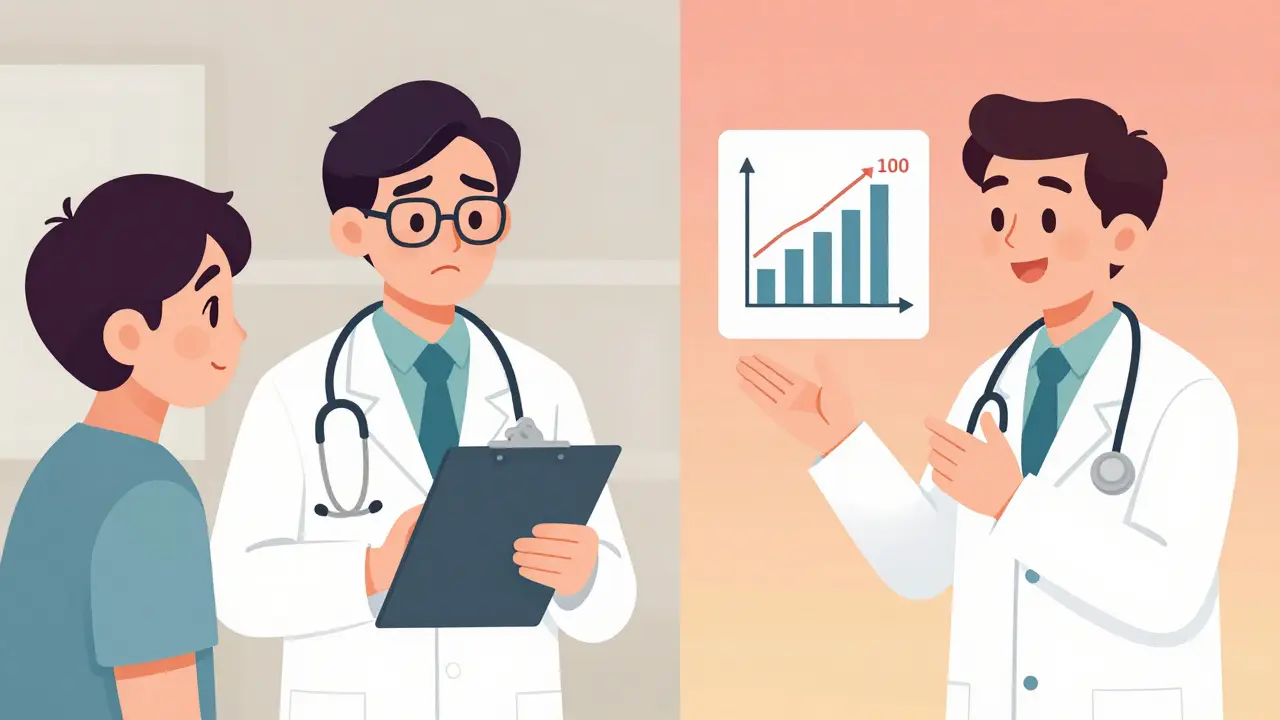
Some clinics train doctors to recite SHARE steps like a checklist. They ask: “What concerns you most?”-then immediately move on. No listening. No follow-up. No adjustment.
That’s when patients feel manipulated. A 2022 study in the Journal of Patient Experience found rigid use of scripts led to a 19% drop in satisfaction. Patients don’t want robotic questions. They want to feel heard.
Dr. Robert Kaplan from UCLA warned that over-structuring dialogue turns care into a box-ticking exercise. The goal isn’t to complete a model. It’s to build trust.
The best clinicians use the framework as a guide-not a script. They pause. They rephrase. They say: “I hear you’re worried about weight gain. That’s something a lot of patients feel strongly about. Tell me more.”
Real-World Use: Where It Works Best
Shared decision-making isn’t for every situation. In an emergency, there’s no time. But for chronic conditions? It’s essential.
- Statins: 86% of non-adherence is due to side effect fears. SDM cuts discontinuation by 33% when paired with pre-visit videos explaining risks.
- Anticoagulants: Bleeding risk is real. Patients who discuss it with their doctor are 29% less likely to stop the drug after a minor bruise.
- Antidepressants: Weight gain and sexual side effects are top reasons for quitting. Asking “What’s the one thing you can’t live with?” changes everything.
On the flip side, SDM isn’t effective for acute infections or life-threatening conditions. You don’t need a 10-minute chat before giving antibiotics for sepsis. But for medications you’ll take for years? This is where it saves lives-not just by improving adherence, but by reducing regret.
How Clinicians Are Learning to Do This
Training isn’t optional anymore. The American Medical Association now has CPT codes (96170-96171) that pay doctors $45-$65 for documented shared decision-making visits. That’s a big incentive.
At Scripps Health, doctors complete a 4-hour training with role-playing exercises. They need 12 supervised conversations before they’re certified. Why? Because this isn’t just knowledge-it’s a skill. Like playing an instrument. You don’t get good by reading a book.
Electronic health records now include built-in SDM prompts. Epic Systems rolled out modules in 2022 that nudge doctors to ask the right questions during visits for high-risk medications. And Medicare Advantage plans are now required to document these conversations.
What You Can Do Today
If you’re the patient:
- Before your appointment, write down: “What side effect would make me stop this medicine?”
- Ask: “What’s the chance I’ll actually get this side effect? Out of 100 people, how many?”
- Say: “I’m not just asking if it works-I want to know how it will affect my daily life.”
If you’re the provider:
- Use absolute numbers. Never say “rare” or “common.”
- Ask which side effects are deal-breakers-not just “Do you have concerns?”
- Use simple visuals: a red bar for nausea, a yellow bar for fatigue. Show, don’t just tell.
- Don’t rush. If the conversation takes 7 extra minutes, you’ll save 22% in follow-up visits.
The Bigger Picture: Why This Isn’t Just a Trend
This isn’t a fad. The Institute of Medicine called patient-centered care the future back in 2001. Now, 87% of U.S. medical schools teach it. By 2026, 92% of major U.S. health systems will have SDM built into their workflows.
Why? Because patients are demanding it. And the data proves it works. Better adherence. Less regret. Fewer emergency visits. Lower costs.
Side effects aren’t just medical facts. They’re personal. They’re emotional. They’re life-changing. And the best way to handle them isn’t with a pamphlet or a warning label. It’s with a conversation that starts with: “What matters most to you?”
What is shared decision-making in healthcare?
Shared decision-making is a process where patients and clinicians work together to choose a treatment based on medical evidence and the patient’s personal values, goals, and concerns. It’s not about the doctor deciding for the patient-it’s about both parties agreeing on the best path forward after discussing risks, benefits, and what matters most in daily life.
Why do side effect trade-offs matter in medication decisions?
Side effects often determine whether a patient sticks with a medication. For example, 86% of people stop statins because of muscle pain or fatigue-not because the drug doesn’t work. If a patient doesn’t understand how a side effect might affect their daily life, they’re more likely to quit treatment, even if it’s helping them live longer. Talking about trade-offs helps patients make choices they can live with.
What’s the difference between relative and absolute risk when talking about side effects?
Relative risk sounds bigger than it is. For example, saying “this drug reduces nausea by 50%” sounds impressive-but if the original risk was only 4%, now it’s 2%. Absolute risk says: “Out of 100 people, 4 get nausea. With this drug, 2 do.” That’s clearer and less scary. Studies show patients understand their actual risk 37% better when absolute numbers are used.
Can shared decision-making be done in a short appointment?
Yes, but it needs preparation. A full SDM conversation adds about 7 minutes to a visit. But if the patient reviews a short video or handout before the appointment, the discussion can be cut down by over 3 minutes. Using focused questions like “What side effect would make you say no?” can get to the heart of the issue in under 5 minutes.
Are shared decision-making scripts effective for all types of medications?
They work best for long-term medications with significant side effects-like statins, blood thinners, antidepressants, and diabetes drugs. They’re less useful in emergencies or for short-term treatments like antibiotics. For chronic conditions where adherence is low, SDM has been shown to reduce discontinuation by up to 33%.
What should I do if my doctor doesn’t talk about side effects?
Ask directly: “What are the most common side effects, and how likely are they?” Then ask: “What side effect would make you not recommend this drug?” If they brush you off, say: “I want to make sure I understand what I’m signing up for. Can we go over the risks again?” If you still feel unheard, consider seeking a second opinion or asking for a referral to a provider trained in shared decision-making.
Next Steps: What to Try This Week
If you’re a patient: Pick one medication you’re taking-or considering-and write down the top three side effects you’re worried about. Bring that list to your next appointment. Ask: “Which of these are most likely to happen to me?”
If you’re a clinician: Pick one patient this week who’s on a medication with high non-adherence rates. Use the SHARE Approach. Ask one open-ended question about their values. Don’t rush. Just listen. You might be surprised what they say.
Shared decision-making isn’t about perfection. It’s about presence. It’s about turning a transaction into a partnership. And in the end, that’s what makes care not just effective-but human.
Alexandra Enns
January 23, 2026 AT 23:26Marie-Pier D.
January 25, 2026 AT 17:02Jamie Hooper
January 27, 2026 AT 13:56Phil Maxwell
January 29, 2026 AT 11:02Shelby Marcel
January 31, 2026 AT 00:57blackbelt security
February 1, 2026 AT 12:52Tommy Sandri
February 2, 2026 AT 03:52Juan Reibelo
February 3, 2026 AT 21:15Luke Davidson
February 5, 2026 AT 10:50Josh McEvoy
February 5, 2026 AT 22:16Heather McCubbin
February 7, 2026 AT 14:49