GMP for Generics: FDA Requirements for Manufacturing Generic Drugs
 Jan, 9 2026
What GMP for Generics Really Means
When you pick up a generic pill at the pharmacy, you expect it to work just like the brand-name version. That’s not luck. It’s because of CGMP - Current Good Manufacturing Practices. These aren’t suggestions. They’re legally required rules enforced by the FDA to make sure every generic drug you take is safe, strong, pure, and consistent - down to the last tablet.
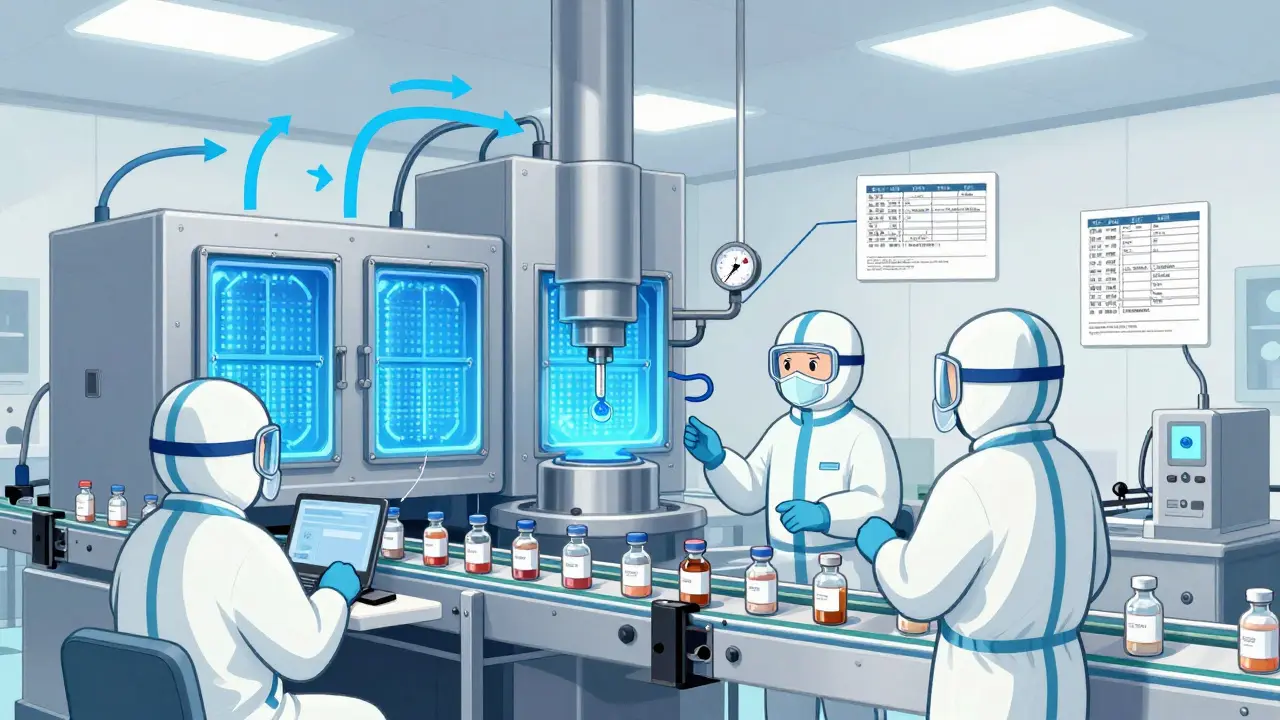
The FDA doesn’t treat generics differently from brand-name drugs when it comes to how they’re made. A generic metformin tablet must be manufactured under the same standards as the original. That means the same clean rooms, the same equipment checks, the same lab testing, and the same paper trails. The only difference? The price. The quality? Identical.
The Core Rules: What 21 CFR Parts 210 and 211 Actually Require
The FDA’s CGMP rules are laid out in 21 CFR Parts 210 and 211. These aren’t vague guidelines. They’re detailed, step-by-step instructions that every generic drug factory must follow. If you skip one, your product can be seized, your facility shut down, or your company fined.
- People matter. Every employee who touches the drug - from the chemist to the packager - must be trained, documented, and qualified. Training isn’t a one-time event. It’s annual, tracked, and audited.
- Facilities must be controlled. Air quality, humidity, temperature - all monitored. Dust? Not allowed. Contamination? Not acceptable. The environment is part of the product.
- Equipment is calibrated, not just cleaned. Every machine used to mix, press, or fill pills must be checked regularly. Calibration records? Kept for at least a year after the drug expires. No exceptions.
- Every ingredient is tested. Active pharmaceutical ingredients (APIs) don’t get a pass. Each batch must be tested for identity, strength, and purity before it’s used. No guessing. No shortcuts.
- Process validation isn’t optional. You can’t just say, “It worked once, so it’ll work again.” You have to prove, with data, that your process consistently produces the same result. Most companies use three consecutive batches to prove it - but the FDA doesn’t mandate the number. They mandate the proof.
- Labels are checked twice. A wrong label on a blood pressure pill can kill. That’s why every label must be verified by a second person before it goes on the bottle. And those labels? They must match the exact strength and name approved by the FDA.
- Lab controls are strict. Stability testing? Required. How long will the drug stay effective? You have to prove it. Microbial testing? Required. Even for non-sterile pills, you can’t have mold or bacteria creeping in.
- Records last longer than the drug. Every batch record, every test result, every maintenance log - kept for at least one year after the product expires. That’s often five, six, or even ten years. The FDA can come back and ask for them anytime.
Why ‘Current’ Matters: CGMP Isn’t Static
The ‘C’ in CGMP stands for ‘Current.’ That means you can’t rely on 1990s methods just because they used to work. The FDA expects you to use modern tech - digital records, automated systems, real-time monitoring - if they’re better than the old way.
Take electronic batch records. In 2023, a mid-sized generic manufacturer in Ohio spent $1.2 million and 14 months switching from paper logs to an electronic system to meet 21 CFR Part 11. Why? Because handwritten notes can be erased. Digital audit trails can’t. The FDA now expects digital integrity. If you’re still using clipboards, you’re already behind.
And it’s not just about tech. In May 2023, the FDA issued an immediate guidance requiring all manufacturers to test high-risk ingredients like glycerin and sorbitol for toxic contaminants like diethylene glycol - after deaths in Pakistan were linked to contaminated generics. That rule didn’t wait for a public comment period. It went into effect the day it was published. Companies had to change their testing protocols overnight.

Inspections: The Hammer Behind the Rules
The FDA doesn’t just write rules - they send inspectors. Domestic generic drug plants get inspected about 1.3 times per year on average. Foreign facilities? Less often. But that’s changing. The FDA’s 2023-2027 plan allocates 25% more resources to inspect overseas factories, where 63% of data integrity violations are found.
Inspections aren’t surprise visits. But they’re not scheduled like a dentist appointment either. You get a few days’ notice - sometimes less. And inspectors don’t just look at paperwork. They walk the floor. They check equipment. They interview workers. They pull samples.
What gets flagged most? Laboratory controls and production process controls. That’s 41% of all violations in 2022. Why? Because those are the areas where corners are cut. A lab might skip a test. A process might be tweaked without validation. The FDA catches it. And when they do, they issue a Warning Letter. Get two? Your product can be banned from U.S. shelves.
Real-World Failures and Successes
Not every company gets it right.
In 2022, 12 generic metformin products were recalled because of NDMA - a probable carcinogen - found in the batches. The FDA’s investigation found the root cause: poor process controls and unvalidated cleaning procedures. The company didn’t test for the contaminant. They didn’t have a plan. They failed CGMP.
But there are wins too. Teva Pharmaceutical implemented continuous manufacturing for a generic heart drug in 2021. Instead of making one batch at a time, they ran a constant flow. Result? Batch failures dropped from 4.2% to 0.7%. And they stayed fully CGMP-compliant. The FDA called it a case study in innovation.
Small manufacturers struggle. A 2022 survey found 68% of generic drug companies have trouble with documentation. Compliance costs hit $2.3 million a year for mid-sized firms. That’s why many small players get bought out by big companies who can afford the systems. The market isn’t fair - but the rules are.
Global Standards: How FDA Compares
The FDA’s CGMP rules are among the strictest in the world. The European Medicines Agency (EMA) follows similar rules - about 85% aligned, according to ICH assessments. But the FDA is more detailed. More rigid. More frequent.
For example, the EMA allows some flexibility in documentation format. The FDA doesn’t. The EMA might accept a verbal report in rare cases. The FDA requires written proof. The EMA inspects foreign plants every 3-5 years. The FDA’s goal is every 2-3 years - and they’re pushing to do more.
That’s why Indian and European manufacturers dominate the global generic market. They’ve built factories to meet U.S. standards - not just their own. Because if you want to sell in the U.S., you have to pass the FDA’s bar.

What’s Next for CGMP?
The future of generic manufacturing is digital. The FDA is already testing AI-driven systems that predict quality issues before they happen. By 2028, 65% of manufacturers are expected to use predictive analytics to monitor production in real time.
Continuous manufacturing - once seen as risky - is now being embraced. The FDA’s Emerging Technology Program is drafting new guidance to make it easier for companies to adopt these systems without breaking CGMP.
Supply chain security is the next frontier. The Drug Supply Chain Security Act is pushing for full traceability of every ingredient from source to shelf. That means you’ll need to track your API supplier’s supplier’s supplier. It’s complex. It’s expensive. But it’s coming.
How to Get Started
If you’re building a generic drug facility, don’t start with equipment. Start with your Quality Management System (QMS). Document every process. Train every person. Validate every step. It takes 18 to 24 months from ground-breaking to first commercial batch.
Use FDA’s guidance documents. They’re clear, detailed, and free. The ‘CGMP for Finished Pharmaceuticals’ guide has a 92% satisfaction rating from manufacturers. Don’t guess. Read it. Follow it.
And don’t try to cut corners on training. Invest in certified professionals - ASQ Certified Quality Engineers, for example. They command 22% higher salaries because they know the rules inside and out. That’s not a cost. It’s insurance.
Bottom Line
CGMP for generics isn’t about bureaucracy. It’s about trust. When you take a generic pill, you’re trusting that it’s as good as the brand. The FDA’s rules are how that trust is kept. It’s expensive. It’s complex. It’s demanding. But it works. Every day, millions of people rely on these drugs. And every day, CGMP ensures they’re safe.
Are generic drugs held to the same manufacturing standards as brand-name drugs?
Yes. The FDA requires generic drugs to be manufactured under the exact same Current Good Manufacturing Practices (CGMP) as brand-name drugs. This includes identical standards for facilities, equipment, personnel training, testing, and documentation. The only difference is the cost - not the quality.
What happens if a generic drug manufacturer fails an FDA inspection?
If a facility fails an inspection, the FDA issues a Warning Letter. The company must fix the issues and submit a detailed corrective plan. If they don’t respond adequately, or if violations are repeated, the FDA can block the drug from entering the U.S. market. In serious cases, the facility may be shut down, and executives can face civil penalties.
Do foreign generic drug manufacturers follow the same CGMP rules as U.S. ones?
Yes. All facilities - whether in the U.S., India, China, or Germany - must meet the same FDA CGMP standards to sell drugs in the United States. However, foreign facilities historically received fewer inspections. Starting in 2023, the FDA is increasing inspections of overseas plants by 25% to close this gap.
What are the most common CGMP violations in generic drug manufacturing?
The top two violations are related to laboratory controls (like skipping stability tests) and production process controls (like failing to validate a manufacturing step). Data integrity issues - such as altered or deleted electronic records - are also rising, especially at foreign facilities. These account for over 40% of all FDA warning letters.
How much does CGMP compliance cost a generic drug manufacturer?
For mid-sized generic manufacturers, annual CGMP compliance costs average $2.3 million. This includes training, equipment calibration, documentation systems, lab testing, and audit preparation. For large companies, it’s a smaller percentage of revenue. For small firms, it’s often a barrier to entry - which is why the industry is consolidating.
Is electronic record-keeping required under CGMP?
The FDA doesn’t require electronic records, but if you use them, you must comply with 21 CFR Part 11. That means secure access, audit trails, and data integrity. Paper records are still allowed, but they’re harder to audit and more prone to errors. Most manufacturers now use electronic systems because they’re more reliable and reduce compliance risk.
What’s the difference between GMP and CGMP?
GMP stands for Good Manufacturing Practices - a general concept. CGMP stands for Current Good Manufacturing Practices. The ‘C’ means manufacturers must use up-to-date technologies and systems. You can’t rely on outdated methods just because they were acceptable 20 years ago. The FDA expects continuous improvement.
Priya Patel
January 11, 2026 AT 09:56Just got back from visiting a generic pharma plant in Hyderabad-same clean rooms, same automated systems as the ones in New Jersey. The only difference? The chai breaks are longer. 😊
Christian Basel
January 13, 2026 AT 08:18CGMP is just regulatory theater. They enforce 21 CFR 211 like it’s gospel, but half the violations are paperwork nitpicks. Real quality? It’s in the process, not the logbooks.
Michael Patterson
January 14, 2026 AT 14:36So the FDA says you need digital audit trails but still lets companies use paper logs? That’s like requiring seatbelts but letting you drive with your feet. And don’t even get me started on how half the labs in India still use Excel sheets for stability data. Typo in the batch number? Oops, here’s your recall.
Matthew Miller
January 16, 2026 AT 05:47Let’s be real-this whole CGMP thing is a scam. Big pharma uses it to crush small players. $2.3M/year just to prove you didn’t sneeze on a pill? Meanwhile, the brand-name guys get to charge $1000 for a pill that costs 50 cents to make. Wake up.
Madhav Malhotra
January 16, 2026 AT 18:06As someone from India, I’ve seen both sides. Our factories meet FDA standards because we know the U.S. market is worth it. But the pressure? Insane. Workers pull 14-hour shifts to hit validation targets. We’re not cutting corners-we’re just working harder than you think.
Jason Shriner
January 18, 2026 AT 09:47So the ‘C’ in CGMP means ‘Current’… but the FDA still hasn’t figured out that humans make mistakes? Cool. I’ll just hand my tablet to a robot and let it sign off on my batch records. 🤖
Sean Feng
January 18, 2026 AT 10:58Inspections every 1.3 times a year? That’s not a schedule. That’s a suggestion. And you think foreign plants get 25% more inspections? Good luck with that. The FDA’s budget is a meme.
Sam Davies
January 18, 2026 AT 11:46Oh, the EMA is ‘only’ 85% aligned? How quaint. The FDA’s obsession with documentation reads like a 19th-century bureaucratic novel. Meanwhile, the rest of the world just… makes medicine. And people don’t die. Shocking, I know.
Alex Smith
January 19, 2026 AT 00:07Continuous manufacturing dropping failures from 4.2% to 0.7%? That’s not innovation-that’s math. Why is this even a surprise? If you automate the right parts, you remove human error. Simple. The FDA’s slow adoption is the real bottleneck.
Roshan Joy
January 19, 2026 AT 01:30Love how this post breaks it all down. One thing I’d add-training isn’t just about compliance. It’s about pride. When workers know why they’re doing each step, they catch errors before they happen. 🙌
Adewumi Gbotemi
January 20, 2026 AT 07:29Simple truth: if you can’t afford CGMP, you shouldn’t make medicine. It’s not about being rich. It’s about not killing people.
Jennifer Littler
January 22, 2026 AT 00:2121 CFR Part 11 compliance is a nightmare. I’ve spent more time auditing digital signatures than I have on actual product testing. And yes, I’m still using a paper backup. Because trust me, the system crashes.
Alfred Schmidt
January 23, 2026 AT 02:37Why are we even talking about this? The FDA is a broken institution. They shut down plants over a missing signature but let companies import APIs from places where they test for contaminants… once a year. This isn’t safety-it’s performance art.
Priscilla Kraft
January 24, 2026 AT 01:04Just wanted to say thank you for this. As a quality engineer, I’ve seen how much work goes into this. And yes, it’s exhausting. But when a mom gives her kid a generic asthma inhaler and it works just as well as the brand? That’s why we do it. 💙