Future Legal Developments: Proposed Laws and Regulatory Changes 2026
 Apr, 1 2026
You might have noticed the paperwork piling up faster than usual this year. By April 2026, the landscape of American law is shifting beneath our feet. If you manage a business or simply follow your paycheck closely, this isn't just noise from Washington. We are seeing a documented increase of more than 13% in state-level regulatory changes compared to 2024. This isn't a hypothetical scenario anymore. Over 4,800 actionable regulations were identified and published in 2024 alone. When we talk about future legal developments today, we aren't discussing distant possibilities. We are navigating an active construction zone.
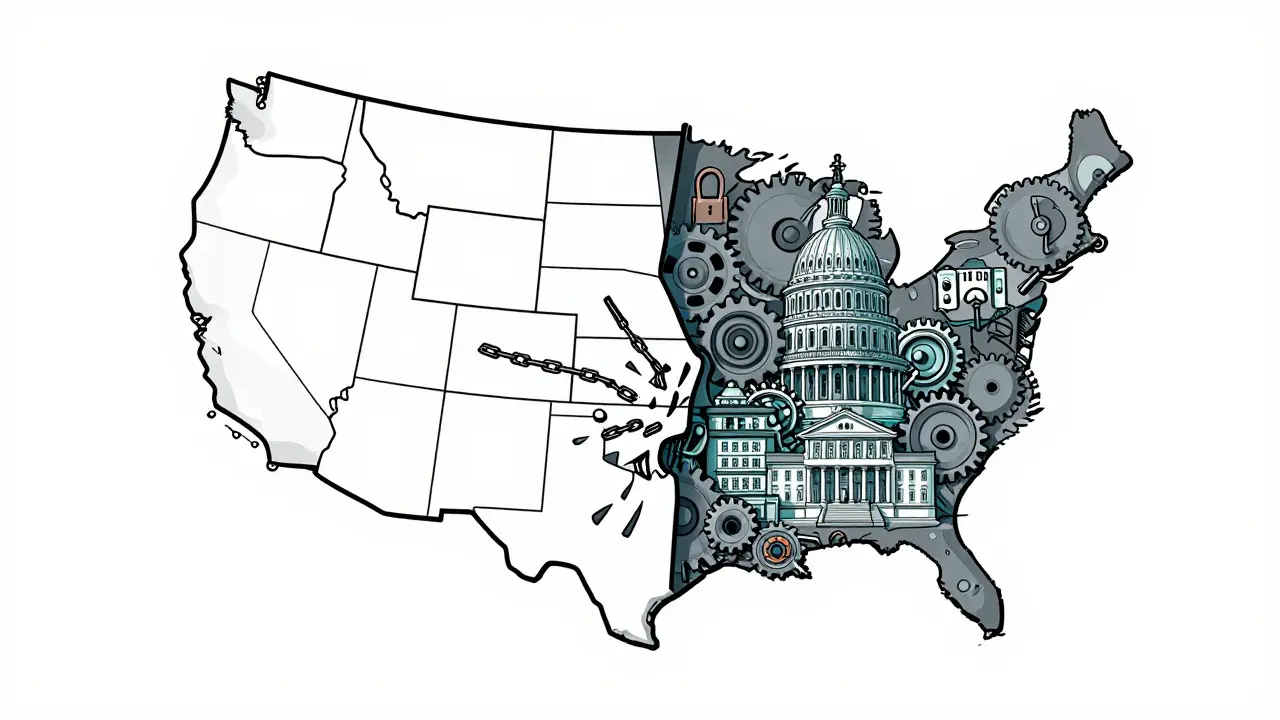
The core issue facing organizations and individuals right now is the split in direction. While some parts of the federal government push for deregulation, states are actively expanding their own rules. This creates a complex environment where being compliant in one place might make you non-compliant in another. Understanding the specifics of this divergence is the only way to stay ahead. Let's break down the major shifts affecting labor, taxes, housing, and safety.
Understanding the Federal-State Divergence
The most significant trend defining the current period is what experts call "diverging priorities." Federal agencies have signaled looser oversight around areas like Medicare Advantage, ACA subsidies, and anti-money laundering rules. At the same time, state legislatures are rolling out stricter requirements. According to mid-2025 tracking data from RegEd, there were nearly 1,200 securities regulations and 2,700 state insurance compliance requirements published recently.
This creates a tricky situation for anyone operating across borders. A company based in California faces different hurdles than one headquartered in Texas. The California Chamber of Commerce notes that regulatory change management is no longer episodic. It has become a constant, enterprise-wide effort. You need systems that can translate evolving rules into operational controls instantly. Waiting for a manual review process often leads to gaps that regulators spot quickly.
The 119th Congress represents the legislative body driving many federal changes during the 2025-2026 session. They advanced notable bills including tax reform and sentencing amendments. Unlike previous sessions, this Congress moved quickly to pass sweeping measures affecting daily financial lives.
Major Shifts in Labor and Employment
Employment law is where the rubber meets the road for most workers. California continues to set the pace for labor standards that often ripple outward. Senate Bill 642 modified pay scale disclosure requirements, meaning job postings must now be more transparent about compensation ranges. This aims to close wage gaps, but it requires HR departments to audit their internal comp bands regularly.
Even more immediate was Assembly Bill 406, which took effect on October 1, 2025. This bill consolidated victims' leave provisions. It merged Labor Code sections regarding family members of victims into the Fair Employment and Housing Act. For employers, this meant updating handbooks and model notices. Specifically, you had to look out for the updated notice titled "Survivors of Violence and Family Members of Victims Right to Leave and Accommodations." The Civil Rights Department likely updated these documents following the implementation.
There is also the expansion of paid sick leave. California's Paid Family Leave program eligibility now includes individuals caring for a seriously ill designated person. This definition is broad. It covers care recipients related by blood or those whose association is the equivalent of a family relationship. While full effect comes later, the preparation starts now. Training costs for these changes averaged between $1,200 and $1,800 per employee for large California employers. That adds up fast if you have a distributed team.

Tax Changes and the One Big Beautiful Bill
Money matters significantly in the regulatory world. Public Law 119-21, colloquially known as the "One, Big, Beautiful Bill," was signed into law on July 4, 2025. This legislation introduced several tax adjustments that affect individual filers for tax years 2025 through 2028.
One Big Beautiful Bill a major piece of legislation (Public Law 119-21) enacted in 2025 introducing significant tax reforms. Key provisions include a new $6,000 deduction for individuals aged 65 and older.
If you are over 65, that deduction is a direct hit to your taxable income. But there are other moving parts. The IRS issued multiple implementation notices, such as IR-2025-107 in October 2025. This notice reverted the Form 1099-K reporting threshold back to $20,000. For gig workers and small merchants using platforms like payment processors, this threshold change alters who gets flagged for income reporting. You should verify your transaction volume against this limit annually.
Tax professionals saw this shift too. Enrollment in continuing education courses for 2025 tax updates jumped 40% compared to 2024. This suggests that accountants recognize the complexity. The IRS also released tax inflation adjustments for the 2026 tax year later in October 2025. Planning for the next year requires checking these specific inflation factors rather than guessing based on past rates.
Sector-Specific Reforms: Housing and Firearms
Not all regulations apply equally to every industry. In housing, California Governor Gavin Newsom signed transformative legislation as part of the 2025-2026 budget. Assembly Bill 130 and Senate Bill 131 implemented sweeping CEQA exemptions. The California Environmental Quality Act (CEQA) usually slows down development with environmental reviews. These trailer bills aimed to speed up production by breaking down barriers for critical housing.
CEQA Exemptions regulatory modifications reducing environmental review timelines for qualifying housing projects in California. The California Building Industry Association estimates these reduce project approval processes by 18 to 24 months.
This is a massive deal for developers. An 18-month reduction in approval can save millions in carrying costs. However, this acceleration requires strict adherence to the new definitions of "critical housing." Misclassifying a project could trigger lawsuits from advocacy groups opposed to the exemptions.
In another sector, firearm owners face changing rules under H.R.2243, the LEOSA Reform Act of 2025. This bill broadened authority for qualified active and retired law enforcement officers. It permits carrying firearms across state lines in specific zones like school zones and national parks, which were previously restricted. States were also given the ability to reduce qualification standard frequency requirements for retired officers. While this seems niche, it touches constitutional rights and Second Amendment interpretations.
Navigating Compliance and Risks
Compliance isn't just about reading the new laws. It's about building a defense. Organizations that treat compliance as a periodic activity face higher risks. PwC analysis suggests failure to adapt could result in 15-25% higher compliance costs. Many companies increased compliance staff by 15-20% in response to the volume of changes.
Technology plays a role here too. Gartner projected 35% year-over-year growth in regulatory technology solutions for 2025. AI-powered monitoring systems are becoming standard for Fortune 500 companies. But smaller businesses still struggle. You don't necessarily need a million-dollar software suite. Start with a robust calendar system that tracks deadline triggers. Cross-functional collaboration is vital. HR shouldn't work in silos from Legal, and Finance shouldn't ignore Regulatory notices.
We also cannot ignore the Supreme Court. The 2025-2026 term marks 20 years of the Roberts Court. Analysis suggests decisions could expand presidential power while limiting certain constitutional rights. Legal departments increased constitutional law expertise by 25% anticipating this. This means litigation risks may shift toward administrative law cases. If your organization relies on federal grants or licenses, keep an eye on how judicial philosophy interacts with executive agency powers.
Actionable Steps for 2026
To stay compliant, you need a plan beyond general awareness.
- Review your employee handbooks immediately for victims' leave language required by AB 406.
- Verify your tax filing strategy regarding the new senior deduction and 1099-K thresholds.
- Audit state-specific insurance requirements if you operate across multiple jurisdictions.
- Implement a quarterly regulatory scan to catch emerging state bills before they pass.
- Investigate automated compliance tools if manual tracking becomes unmanageable.
The volume of 1,200 additional regulatory changes expected in the second half of 2025 alone proves that standing still is risky. Adaptation is the new norm. Whether you are a homeowner in California or a small business owner using payment apps, understanding the source of these rules helps you protect yourself.
What is the main difference between federal and state regulations in 2026?
The primary difference is that federal efforts often lean toward deregulation in sectors like healthcare benefits, while state levels are expanding regulations, particularly in labor and consumer protection.
Does the One Big Beautiful Bill affect people under 65?
While the specific $6,000 deduction targets individuals aged 65 and older, the bill also adjusted IRS reporting thresholds like Form 1099-K, which impacts younger taxpayers and small businesses.
Which California labor laws changed in late 2025?
Key changes included Assembly Bill 406 consolidating victims' leave and Senate Bill 642 modifying pay scale disclosure requirements effective shortly after enactment.
How do housing regulations impact developers?
New CEQA exemptions in AB 130 and SB 131 can reduce project approval timelines by 18 to 24 months, though developers must qualify for these specific infrastructure exemptions.
Is compliance software necessary for small businesses?
It depends on your scope. While AI monitoring is growing, even basic calendar systems tracking deadlines help mitigate the risk of missing 13% increases in state-level regulation.
Rob Newton
April 1, 2026 AT 15:52This analysis lacks nuance regarding the actual impact on small businesses.
simran kaur
April 3, 2026 AT 06:57People ignore the deeper connections here. They think it is just paperwork. But the data points show a pattern of control. State alignment requires direct instruction from above. It is too synchronized to be accidental chaos. Notice how the insurance rules match the tech timelines perfectly. They want to track every dollar you move online. The payment processor threshold change is not about fraud prevention. It is about visibility into personal spending habits. Corporations love these reporting mechanisms because it creates barriers for competitors. Small business owners are the first line of defense against monopoly. These bills kill innovation under the guise of safety. You cannot trust the statistics they provide either. They curate the numbers to keep fear high. We need to question the source of every single regulation document. Staying aware is the only way to survive this gridlock.
Jenna Carpenter
April 4, 2026 AT 18:22I cant beleive how much red tape they piling up agin.
Brian Shiroma
April 6, 2026 AT 02:52Oh wonderful, another reason to fill out forms we did not need before. The bureaucracy thrives on our confusion.
Mark Zhang
April 7, 2026 AT 14:27It is good to see people engaging with these changes proactively. Understanding the landscape helps mitigate risk effectively.
Vicki Marinker
April 7, 2026 AT 21:41The distinction between federal and state jurisdiction remains woefully unclear in practice. Compliance officers face impossible choices daily.
Aysha Hind
April 9, 2026 AT 06:09They are watching us through the compliance software. The digital leash tightens with every update. You cannot escape the tracking protocols embedded in payroll systems.
Dipankar Das
April 9, 2026 AT 11:38Adherence to such regulations ensures societal stability. Following the law protects the community infrastructure.
Lawrence Rimmer
April 10, 2026 AT 01:00Compliance is just fear management really. Humans submit to rules when consequences appear severe.
Hope Azzaratta-Rubyhawk
April 11, 2026 AT 07:49We will overcome these hurdles together and thrive despite the obstacles! Adaptation drives success in volatile markets.
Hudson Nascimento Santos
April 13, 2026 AT 04:04The nature of law is fluid by definition. Static interpretations fail against dynamic governance models.
The Charlotte Moms Blog
April 14, 2026 AT 08:13This is absolutely unfair!!! How dare they!!!
Rachelle Z
April 14, 2026 AT 16:14So tired of this...!!! 🤦♀️😂 Love seeing taxpayers panic again.
sophia alex
April 14, 2026 AT 22:00Our sovereignty is being eroded by these bureaucratic overreaches 🇺🇸😡 We must fight back hard.