Fiber Supplements and Constipation: When to Take Them With Medications
 Feb, 7 2026
Medication & Fiber Timing Calculator
Medication Timing Setup
Enter the times you take your medications to calculate proper timing with fiber supplements.
Optimal Fiber and Medication Timing
Follow this schedule to maximize medication effectiveness and avoid interactions:
Constipation is one of the most common digestive complaints, and fiber supplements like psyllium (found in Metamucil) are often the first thing doctors recommend. But here’s the catch: if you’re taking medications, taking fiber at the wrong time can make those meds less effective-or even dangerous. It’s not just about getting more fiber. It’s about timing.
Why Fiber Can Interfere With Medications
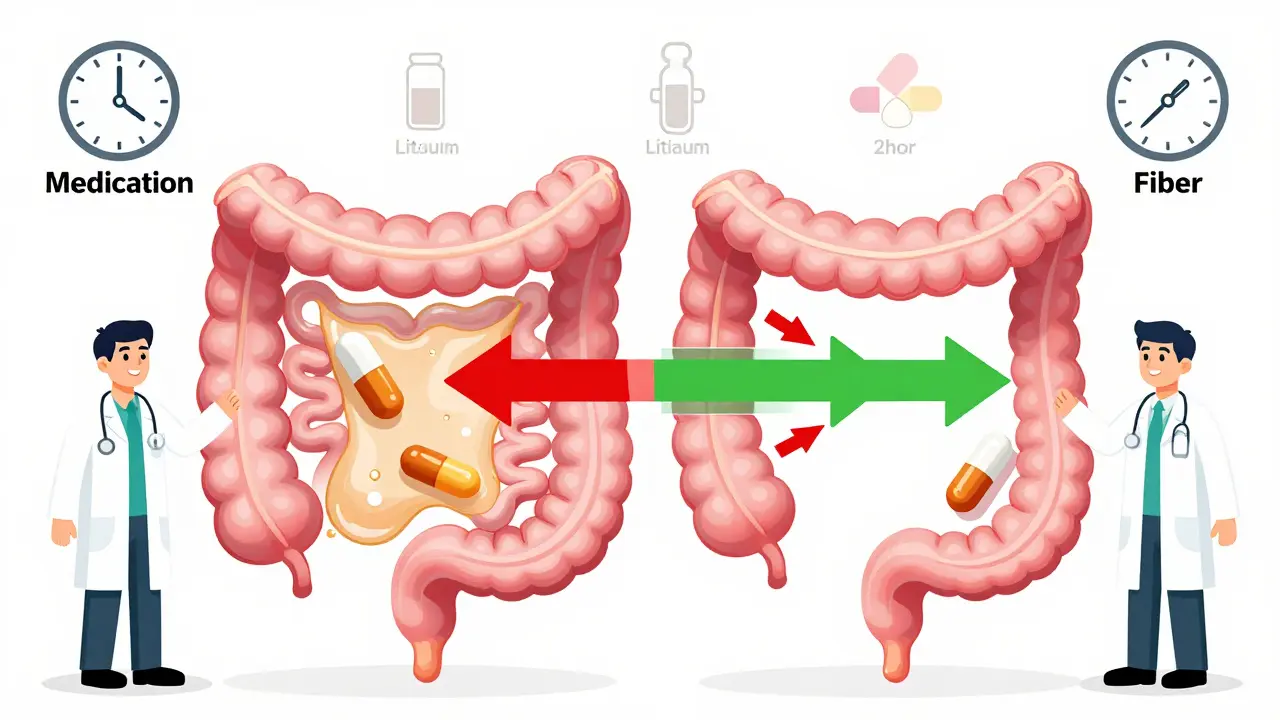
Fiber supplements, especially psyllium husk, turn into a thick gel when they mix with water in your gut. That gel is great for softening stool and helping you go more regularly. But it’s also a sponge for everything else in your digestive tract-including the pills you take. This gel can trap medications, slowing down or blocking their absorption. That means your blood pressure pill, diabetes drug, or antidepressant might not work as well.The American Gastroenterological Association confirms this. Fiber changes how fast food and drugs move through your stomach and intestines. If you take your metformin at the same time as your fiber, your blood sugar might spike because the metformin didn’t get absorbed properly. Same goes for lithium, carbamazepine, or olanzapine. These aren’t theoretical risks-they’re documented problems.
What the Experts Say About Timing
You’ll find conflicting advice online. Some say take fiber at night. Others say take it in the morning. Here’s what the real guidelines say:- Metamucil’s official label: Take fiber supplements at least 2 hours before or after any medication.
- For specific drugs like metformin, lithium, carbamazepine, and olanzapine: Wait 4 hours after taking the drug before taking fiber, or take fiber 2 hours before the drug.
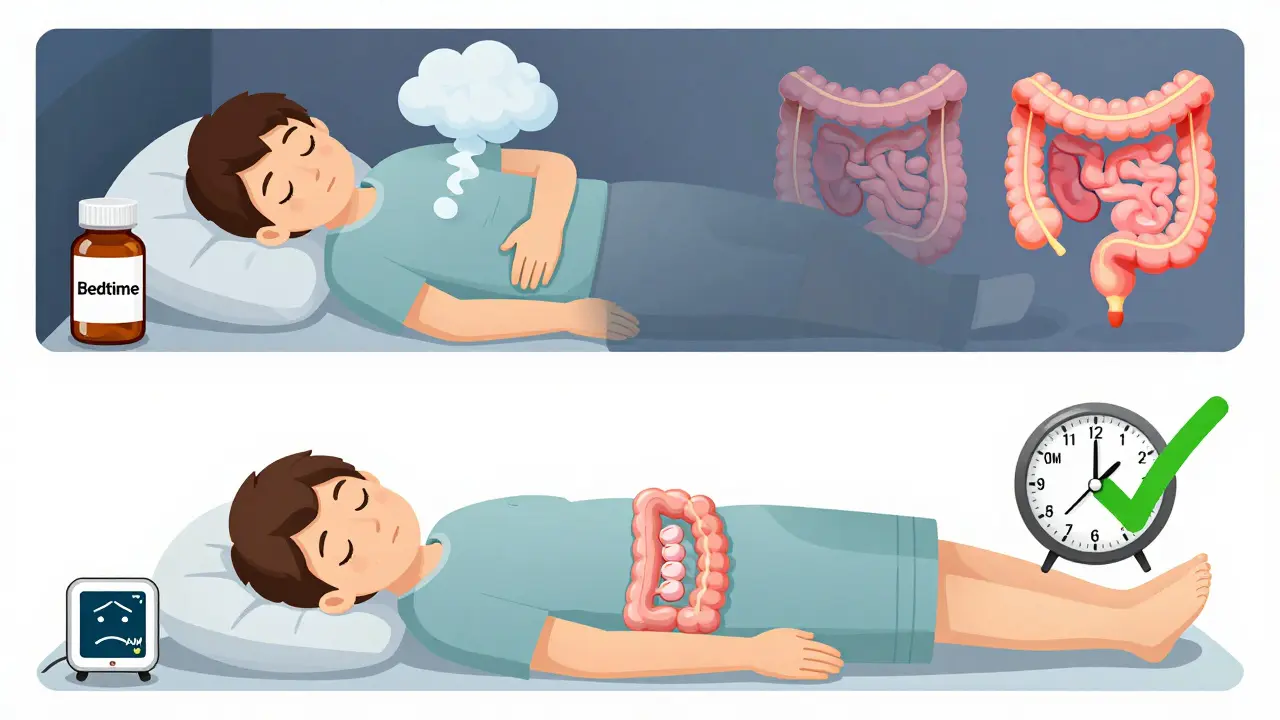
- Nature Made suggests taking fiber before bed if you take meds in the morning-but this isn’t always safe.
- SAMPA Docs recommends afternoon or evening fiber if your meds are morning doses.
- FreeRx warns against bedtime fiber: it can cause bloating, gas, and cramps that wreck your sleep.
So what’s the right answer? The safest, most consistent advice across medical sources is this: Separate fiber and medications by at least 2 hours. If you’re on multiple meds, aim for 4 hours if possible.
Real-World User Experiences
People aren’t guessing-they’re sharing what actually works. On Reddit’s r/medication community, 67% of 142 users reported their meds didn’t work as well when taken with fiber. Over 40% said their metformin lost effectiveness. On FreeRx, 217 users described sleepless nights after taking fiber before bed. Eighty-two percent fixed the problem by switching to morning fiber.Nature Made’s customer reviews show a clear pattern: fiber taken 20-30 minutes before meals got a 4.2/5 rating. Fiber taken before bed? Only 3.1/5. Why? Because midnight bathroom trips and bloating are common-and annoying.
The most successful strategy? Take fiber at the opposite time of your meds. If you take blood pressure pills at night, take fiber in the morning. If you take thyroid meds at 7 a.m., take fiber after lunch. This simple swap worked for 72% of users on SAMPA Docs’ patient portal.
How Much Fiber? And How to Take It Safely
Not all fiber is the same. Psyllium husk is the most effective for constipation, backed by a 2022 meta-analysis showing it increases bowel movements by about 3 per week. That’s better than many laxatives.Metamucil capsules each contain 5 grams of fiber (3 insoluble, 2 soluble). To hit the effective dose, you need at least 10 grams per day-so two capsules twice a day. But don’t jump in. Start with one serving a day. Give your body a week to adjust. You might get bloated at first. That’s normal. If it lasts more than two weeks? Stop and talk to your doctor.
And here’s the non-negotiable rule: Always take fiber with at least 8 ounces (237 mL) of water. Fiber without enough liquid can swell and block your throat or esophagus. That’s not a myth. It’s a real, documented risk-especially for older adults or anyone with swallowing issues.

When to Stop Taking Fiber
Fiber isn’t harmless. If you start having abdominal pain, nausea, vomiting, or rectal bleeding-stop immediately. These aren’t just side effects. They could mean something serious: a bowel obstruction, diverticulitis flare-up, or even colon cancer.UCSF Health tells patients: If constipation lasts more than 7 days despite fiber, or if you notice blood in your stool, see a doctor. Don’t assume it’s just “not working.” It might be something worse.
Who Should Be Extra Careful?
Not everyone should use fiber supplements. People with:- Active diverticulitis (fiber can worsen inflammation)
- Intestinal blockages or narrowing
- Swallowing disorders
- Recent abdominal surgery
need to be especially cautious. Post-bariatric surgery patients, for example, have tiny stomachs and slow digestion. Fiber can cause dangerous blockages if not timed perfectly. Specialized groups like SAMPA’s bariatric community offer tailored schedules for these cases.
What About Insurance and Cost?
Fiber supplements cost money. In the U.S., 63% of commercial insurance plans treat them like over-the-counter items-no coverage. Medicare Part D will cover them if prescribed for conditions like IBS with constipation. But if you’re buying them yourself, you’re paying full price.That’s why dosage matters. Taking too little won’t help. Taking too much can cause side effects. Stick to the label: 5 capsules four times a day for heart health (7+ grams of soluble fiber). Two capsules twice a day for constipation. Don’t guess. Measure.
What’s Changing in 2026?
The American Gastroenterological Association just updated its guidelines in early 2024. They now strongly recommend psyllium as the first-line treatment for chronic constipation-and they added specific timing rules for common medications. The FDA also cracked down in late 2023 on supplement makers making false claims about medication safety.And the future? Researchers are testing time-release fiber capsules that release slowly over 6-8 hours. Early trials (NCT05678901) show promise in reducing interactions. The European Medicines Agency calls this innovation “high-potential.” In the next few years, you might be able to take fiber and meds closer together. But for now? Stick to the 2-4 hour rule.
Simple Action Plan
Here’s what to do today:- Check your medication schedule. When do you take each pill?
- Take fiber at least 2 hours before or after each medication. If you’re on high-risk drugs (metformin, lithium, etc.), go for 4 hours.
- Start with 1 serving of fiber per day. Increase slowly over 1-2 weeks.
- Always drink 8 oz of water with every dose.
- Never take fiber before bed if you’re prone to bloating or sleep issues.
- Stop and call your doctor if constipation lasts more than 7 days, or if you have pain, bleeding, or vomiting.
Can I take fiber supplements with my morning medications?
No-not if you take them at the same time. Fiber can block absorption of thyroid meds, blood pressure pills, and diabetes drugs. Wait at least 2 hours after taking your morning meds before taking fiber. Or take fiber in the afternoon or evening, at least 2 hours before your next dose of medication.
Is psyllium better than other fiber supplements for constipation?
Yes. Psyllium husk is the most studied and effective type for constipation. A 2022 review found it increases bowel movements by about 3 per week-better than many laxatives. Other fibers like inulin or methylcellulose don’t have the same level of evidence. Stick with psyllium-based products like Metamucil or generic equivalents.
What happens if I take fiber and medication together by accident?
You might not notice anything right away. But over time, your medication may not work as well. For example, your blood sugar could rise if metformin isn’t absorbed. Your mood or seizure control could be affected if lithium or carbamazepine levels drop. If you accidentally take them together, don’t panic-but don’t do it again. Adjust your schedule to keep them separated.
Can fiber supplements cause constipation instead of helping?
Yes-if you don’t drink enough water. Fiber needs water to work. Without it, fiber can harden and make constipation worse. Also, starting too fast can cause bloating and cramping, which might make you avoid bowel movements. Always start low and go slow. Drink 8 oz of water with every dose.
Should I take fiber supplements every day?
If you have chronic constipation, yes. Fiber supplements are meant for daily use. But only if you’re not having side effects. If you feel pain, bloating lasting more than two weeks, or sudden changes in bowel habits, stop and see your doctor. Fiber isn’t a cure-all-it’s a tool. Use it wisely.
Frank Baumann
February 7, 2026 AT 20:02Look, I’ve been on metformin for 12 years and psyllium for 8, and I swear to god, I used to take them together like it was a protein shake. I thought I was just being efficient. Then one day my glucose readings went from 110 to 210 overnight. No change in diet. No stress. Just one lazy morning where I swallowed my pill and my Metamucil like a smoothie. That’s when I learned fiber isn’t a sidekick-it’s a bodyguard that kicks your meds out of the room. Now I take fiber at 6 p.m. and meds at 7 a.m. It’s a pain, sure, but my pancreas is no longer staging a rebellion.
And don’t even get me started on the bedtime fiber trap. I tried it once. Woke up at 3 a.m. feeling like a balloon full of angry bees. That’s not wellness-that’s a war crime against sleep. If you’re going to live like a monk, at least make it count.
Also, 8 oz of water? Please. I use a whole liter. I’ve seen people choke on dry fiber like it’s a novelty snack. It’s not a snack. It’s a sponge that turns into a clog if you forget the water. I’m not exaggerating. I’ve seen it. I’ve heard the stories. Don’t be that guy.
And yes, I know the FDA’s new rules. I read them. I cried. Then I bought a pill organizer with labeled slots. My life is now a military operation. But hey-I’m alive. And my A1C is stable. Worth it.
Alex Ogle
February 8, 2026 AT 08:05I’ve been quietly following this thread because I’ve been in the same boat. Took fiber with my thyroid med for years. Never thought twice. Then my TSH spiked from 2.1 to 8.7 in three months. My endo looked at me like I’d just confessed to stealing his lunch. Turns out, fiber was blocking absorption-like a silent saboteur.
Switched to taking fiber after lunch, water on the side, no exceptions. Two months later, TSH back to normal. No drama. No panic. Just consistency. It’s not glamorous. It’s not trendy. But it works.
And honestly? The 2-hour rule feels like common sense. Why would you make your body work harder to absorb a pill when it’s already busy processing a gelatinous swamp? Just separate them. Like oil and water. Or exes on a group chat.
Also-psyllium is king. I tried inulin. Felt like I’d swallowed a bag of sawdust. Didn’t help. Psyllium? It’s the only one that actually makes me feel… normal. Not bloated. Not blocked. Just… regular.
Brandon Osborne
February 8, 2026 AT 12:37STOP. JUST STOP. People are treating this like a yoga routine. ‘Oh, I’ll just take fiber whenever I feel like it.’ NO. YOU WON’T. YOU’RE NOT A GOD. YOU’RE A HUMAN WITH A DIGESTIVE SYSTEM THAT DOESN’T CARE ABOUT YOUR ‘FLOW.’
I’ve seen people die from this. Not exaggerating. A guy in my support group took fiber with his lithium. His levels crashed. He had a seizure. In a Walmart parking lot. Because he thought ‘morning’ meant ‘right after coffee.’
You think this is about constipation? No. It’s about your meds NOT WORKING. Your blood pressure stays high. Your diabetes runs wild. Your mood swings into a black hole. And you blame ‘stress’ or ‘bad genes.’
It’s not your genes. It’s your ignorance. Read the label. Or don’t. But don’t come crying when your heart gives up because you thought ‘2 hours’ was a suggestion.
And if you’re taking fiber before bed? You’re not ‘being healthy.’ You’re just being a selfish idiot who doesn’t care about your own sleep-or the people around you who have to listen to you moaning at 2 a.m.
Fix it. Or stop pretending you know what you’re doing.
Lyle Whyatt
February 8, 2026 AT 15:22I’ve lived in Australia, the US, and now Canada, and I’ve seen how different cultures handle this. In the US, people treat fiber like a magic bullet-take it with everything. In Australia? They’re way more cautious. My GP here told me, ‘If you’re on meds, treat fiber like a stranger at a party. Don’t let it get too close.’
And honestly? That’s the best way to think about it. Fiber isn’t evil. But it doesn’t care about your schedule. It just does its job: absorbs everything. So if you’re on anticonvulsants, antidepressants, or anything that needs precise blood levels, you’re playing Russian roulette if you don’t separate them.
I started with one serving of psyllium at 4 p.m., after my afternoon meds. No bloating. No sleep issues. My constipation? Gone in a week. My mood? Stable. My anxiety? Lower. All because I stopped treating fiber like a snack and started treating it like medicine.
Also, water. Always water. I carry a 1L bottle everywhere. It’s not cute. But it’s saved me from three ER visits.
And yes-I’ve tried the bedtime trick. It was a disaster. I woke up with a stomach that felt like a drum. So now? Fiber after lunch. Simple. Safe. Effective.
Random Guy
February 10, 2026 AT 10:15so like… fiber = drug sponge? wow. mind blown. i thought it was just for pooping. turns out i’ve been sabotaging my own meds like a bad roommate who steals your fries.
also, 8oz water? that’s like… one soda can. i drink that in 2 sips. no wonder i felt like a balloon full of rocks.
anyway, i switched to taking fiber at 3pm. no more 3am bathroom marathons. also, my bp didn’t spike this week. maybe i’m not a complete idiot after all. lol.
Chelsea Cook
February 12, 2026 AT 08:33Y’all are overthinking this. Look. You take your meds. You take your fiber. You don’t do them together. That’s it. No need for spreadsheets. No need for PhDs. Just… space them out. Like you space out your coffee and your lunch.
I took fiber with my thyroid med for 4 years. My doctor finally said, ‘You’re not hypothyroid-you’re just not absorbing your med.’ I switched to morning meds, fiber after lunch. My energy? Back. My hair? Stopped falling out. My mood? Not a rollercoaster anymore.
And yes, psyllium works. I tried oat bran. Felt like I swallowed a carpet. Psyllium? Smooth. Gentle. Works. Don’t overcomplicate it.
Drink water. Don’t take it at night. Wait 2 hours. Done. You’re welcome.
Andy Cortez
February 12, 2026 AT 21:41psyllium? more like psyllium-lyin’. everyone’s acting like this is some new discovery. i’ve been taking fiber with my meds since 2018. no issues. maybe i’m just a superhuman. or maybe you’re all overreacting because you don’t know what ‘normal’ feels like.
also, 8oz water? that’s like… a sip. i drink 20oz with my fiber. so i’m clearly doing it right. and my poop? perfect. like, i could be a billboard for it.
and sleep? who cares? i’m a night owl. i take fiber at 11pm. i don’t sleep anyway. so why not? it’s not like i’m on lithium or anything. lol.
also, why do doctors even exist if we’re all just supposed to follow labels? i mean, i’m pretty sure i know my body better than some guy in a white coat.
Andrew Jackson
February 13, 2026 AT 04:42It is a matter of profound moral failure that citizens of this great nation treat pharmaceutical interventions with the casualness of a Sunday brunch. The very notion that one may ingest a pharmacologically active compound in tandem with a viscous, hydrophilic polysaccharide-without regard for pharmacokinetic integrity-is not merely negligent; it is an affront to the scientific method itself.
The American Gastroenterological Association has issued clear, evidence-based guidelines. Yet, the populace, in its collective ignorance, persists in conflating convenience with competence. This is not merely a health issue-it is a societal decay.
Moreover, the casual dismissal of hydration protocols is tantamount to biological sabotage. To ingest fiber without sufficient aqueous medium is to invite intestinal catastrophe. One does not consume dry cement and expect a foundation. Why, then, do we expect fiber to behave otherwise?
I implore you: Revere the label. Honor the timing. Respect the science. Or, at the very least, stop pretending you are qualified to make decisions that impact your own survival.
Tori Thenazi
February 13, 2026 AT 20:29Okay, but have you heard about the 2025 FDA memo? No? Well, I read it. It’s not public yet, but my cousin works at the CDC, and she sent me a PDF. It says that fiber supplements are secretly linked to a government surveillance program. The gel traps not just meds-it traps your DNA. They’re using it to track who’s on which meds. That’s why they’re pushing the 2-hour rule-so you don’t get flagged.
Also, I’ve had three bowel obstructions. All because I didn’t drink enough water. But I’m not just talking about water-I mean alkaline water. With lemon. And Himalayan salt. That’s the real secret. Most people don’t know this. But I’ve been doing it for 12 years. And no, I don’t take fiber at night. Because the moon phase affects fiber absorption. I check the lunar calendar. Every night. And I’ve never had a problem since.
Also, psyllium? I only use the organic, non-GMO, gluten-free, fair-trade, moonlit-harvested kind. The rest? They’re laced with glyphosate. I’ve seen the lab reports. They’re hiding it. I’ve filed FOIA requests. You’re welcome.
Karianne Jackson
February 14, 2026 AT 10:40fiber bad. meds bad. water good. i took fiber at night. woke up sick. now i take it after lunch. better. no more 3am trips. also, drink water. i did. it helped. psyllium good. other fiber no. done.
Jacob den Hollander
February 15, 2026 AT 03:31Hey everyone-I just want to say thank you for sharing your stories. This thread has been so helpful. I’ve been struggling with constipation since my surgery last year, and I was terrified to try fiber because I didn’t want to mess up my meds. But reading all of this? It made me feel less alone.
I started with one teaspoon of psyllium after lunch, with a full glass of water. First day? A little bloated. Second day? Better. Third day? I went. Regularly. No panic. No drama.
I take my thyroid med at 7 a.m. Fiber at 1 p.m. It’s not perfect, but it’s working. And I’m not scared anymore.
To the people who are angry or sarcastic? I get it. You’ve been through it. But this thread? It’s not just about fiber. It’s about people trying to survive. And you’ve all helped someone today. Even if you didn’t realize it.
Keep going. Keep sharing. You’re not just a commenter-you’re a lifeline.