Environmental Monitoring: How to Test Facilities for Contamination
 May, 2 2026
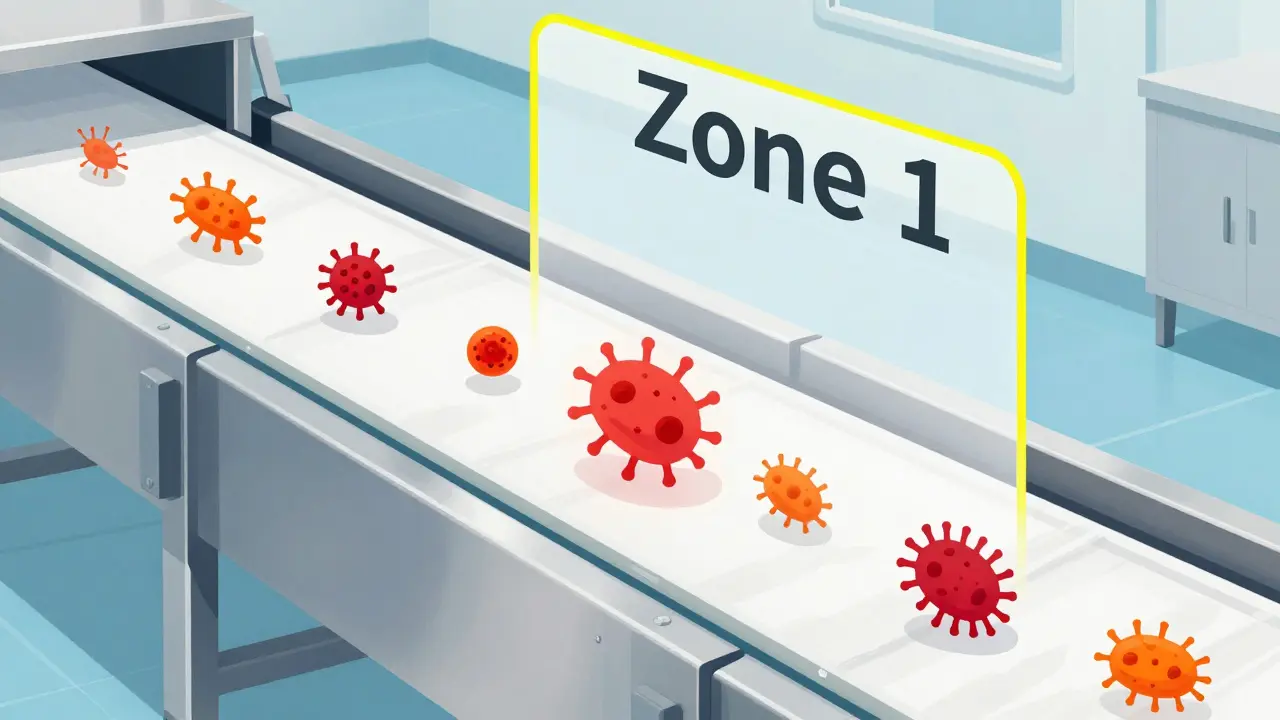
Imagine a single invisible bacterium hiding on a conveyor belt in your food processing plant. It doesn't look like much, but it could trigger a recall that costs millions and ruins your brand's reputation overnight. This is why environmental monitoring is a systematic approach to detecting and controlling contamination in production facilities through regular sampling and testing. It isn't just about cleaning; it’s about proving that your cleaning works before a customer ever gets sick.
Whether you run a pharmaceutical lab or a ready-to-eat (RTE) food facility, the goal is the same: stop contamination vectors before they touch your product. The U.S. Food and Drug Administration (FDA) and other global regulators don’t just want you to clean-they want data. They want proof that your Hazard Analysis and Critical Control Point (HACCP) systems are actually holding the line against microbial hazards.
Why Environmental Monitoring Matters More Than Ever
You might think your facility is clean because it looks clean. But visual inspection misses what matters most. According to the Centers for Disease Control and Prevention (CDC), effective environmental monitoring can identify contamination sources before they impact products. This is critical because foodborne illness outbreaks cost the U.S. economy $77.7 billion annually, according to USDA Economic Research Service data from 2022. Most of these outbreaks are preventable with proper monitoring.
The regulatory landscape has tightened significantly. In the 1990s, the FDA began establishing environmental sampling protocols as part of HACCP systems. By 2008, the European Medicines Agency (EMA) formalized requirements in Annex 1 of Eudralex Vol. 4. Today, the FDA explicitly states that "environmental monitoring and product testing are examples of steps they may take to verify control of microbial hazards." If you aren't monitoring, you aren't verifying. And if you aren't verifying, you're operating on hope, not science.
Understanding Zone Classification: The Foundation of Your Program
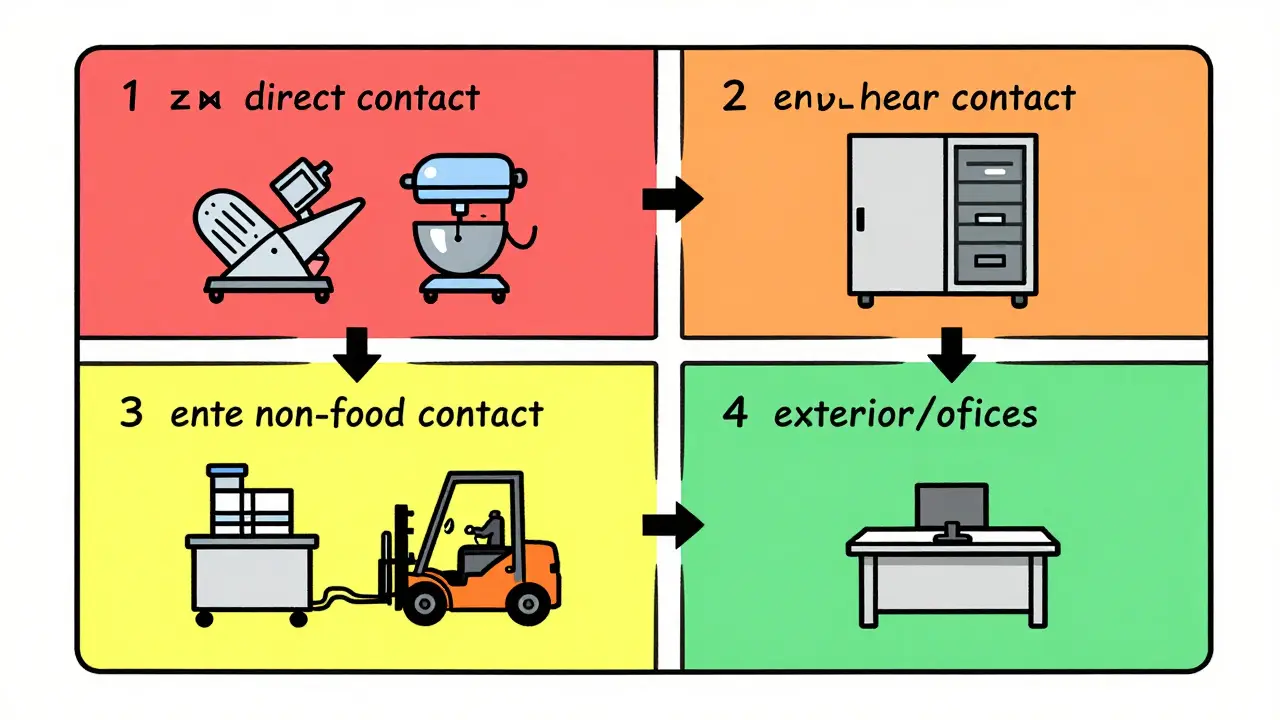
Not all surfaces are created equal. Trying to test every inch of your facility with the same frequency is inefficient and expensive. Instead, successful programs use a zone classification system to prioritize high-risk areas. This framework, detailed in the 3M Environmental Monitoring Handbook published by the International Dairy Foods Association (IDFA), divides your facility into four distinct zones based on risk.
| Zone | Description | Examples | Sampling Frequency |
|---|---|---|---|
| Zone 1 | Exposed food contact surfaces | Slicers, mixers, conveyors, utensils | Daily to Weekly |
| Zone 2 | Non-food contact surfaces near food | Equipment exteriors, refrigeration units | Weekly to Monthly |
| Zone 3 | Remote non-food contact surfaces | Forklifts, remote walls, drains | Monthly to Quarterly |
| Zone 4 | Non-food contact surfaces outside processing | Offices, locker rooms, exterior grounds | Quarterly or As Needed |
Dr. Laurel Dunn of the University of Georgia Cooperative Extension emphasizes that the greatest time and resources should be allocated toward monitoring and cleaning Zone 1 surfaces, followed by Zone 2. However, don't ignore Zones 3 and 4 entirely. A study by PPD Laboratories found that laboratory floors were the source of 62% of all alert and action limit events. Those floors were technically lower-risk zones, yet they harbored significant contamination. Consistent zone classification is key-management at one facility might treat overhead pipes as Zone 1 due to condensation risks, while another treats them as Zone 3. You need a clear, documented policy.
What Are You Actually Testing For?
Your testing strategy depends on what you make. Pharmaceutical facilities often focus on air particulates and specific chemical compounds, while food processors hunt for pathogens. Here’s a breakdown of common analytes and methodologies:
- Microorganisms: General bacteria, specific pathogens (like Listeria monocytogenes or Salmonella spp.), and molds/yeasts. Detected via microbiological methodologies.
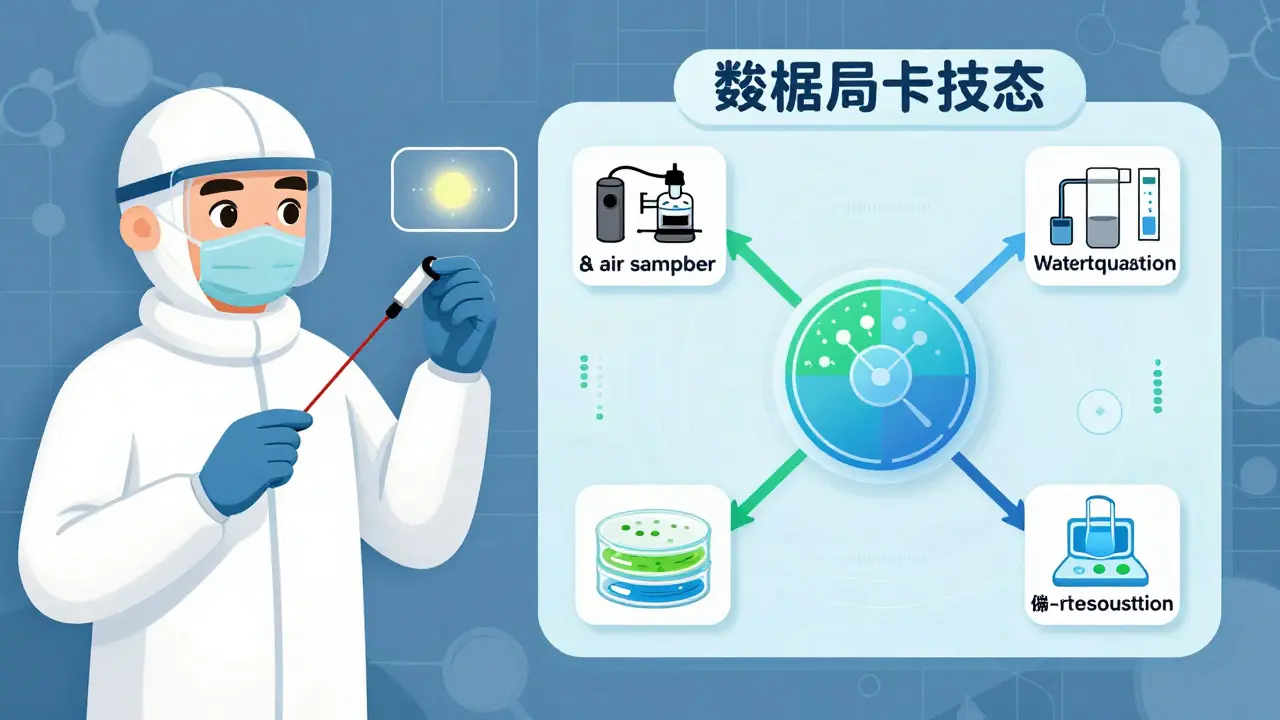
- Air-borne Particulates: Measured using liquid impinger or solid impactor samplers. Results are expressed as organisms or particles per cubic meter of air (CFU/m³). Pharmaceutical cleanrooms require continuous non-viable particle monitoring at ISO Class 5 standards.
- Water Quality: Assessed using Total Organic Carbon (TOC) and conductivity measurements. Pharmaceutical facilities must meet USP <645> standards for purified water systems.
- Metals: Detected using Inductively Coupled Plasma (ICP) methodologies.
- Chemical Compounds: Identified using chromatographic methods like GC, HPLC, UPLC, or IC.
For RTE food facilities, the primary targets are almost always Listeria spp. and Salmonella spp.. The USDA Food Safety and Inspection Service (FSIS) requires aggressive Zone 1-4 testing for Listeria under the "Listeria Rule" (9 CFR part 430). If you’re making cheese, deli meats, or fresh produce, this isn't optional-it's mandatory.
Sampling Techniques: Doing It Right the First Time
You can have the best plan in the world, but if your sampling technique is flawed, your data is useless. The CDC notes that many facilities struggle with proper technique, specifically failing to sterilize the interior of sampler devices, which leads to inadvertent cross-contamination.
Here’s how to avoid common pitfalls:
- Use the Right Swabs: For surface sampling, sterile sponges or swabs are standard. Ensure they are validated for the specific pathogen you’re targeting.
- Air Sampling Protocols: Liquid impingers and solid impactors are practical for sampling large volumes of air quickly. Solid impactors come in "slit" or "sieve" designs and must be sterilized before each use.
- ATP Testing for Speed: Adenosine triphosphate (ATP) testing provides results in seconds, compared to 24-72 hours for traditional microbiological tests. The FDA reports that facilities using ATP for sanitation verification achieve 32% faster turnaround between production runs. Use ATP for immediate feedback, but rely on culture-based methods for definitive pathogen identification.
- Training is Non-Negotiable: The FDA recommends at least 40 hours of hands-on training for personnel conducting official monitoring activities. Don’t let someone learn on the job with live production at stake.
Industry Differences: Pharma vs. Food
Your industry dictates your intensity. Pharmaceutical facilities following EU GMP Annex 1 implement more rigorous air particulate monitoring than food processors. They monitor temperature and humidity continuously in critical areas like warehouses and packaging environments. Their goal is sterility.
Food facilities, on the other hand, prioritize pathogen detection. While pharma labs might worry about viable contamination rates staying below 0.01% of environmental monitoring events, food plants are fighting biological threats that cause acute illness. The adoption rate reflects this difference: 98% of pharmaceutical manufacturers have formal environmental monitoring programs, compared to 76% of food processing facilities, according to an FDA 2022 survey. Small food facilities (<50 employees) lag even further, with only 48% maintaining fully compliant programs.
Integrating Data: The Next Step
Collecting samples is only half the battle. The real value comes from integrating data. The 3M Environmental Monitoring Handbook warns that ATP, allergen, and microbiological tests are often siloed. When you combine them, you get a complete picture. PPD Laboratories found that integrating environmental monitoring data with culture contamination frequency tracking reduced false positive rates by 27%.
Look ahead to where the industry is going. The FDA’s 2023 draft guidance encourages next-generation sequencing (NGS) and metagenomics. These technologies can reduce pathogen identification time from 48-72 hours to under 24 hours. Additionally, AI-powered analytics are growing rapidly, projected to reach 38% market penetration by 2027. These tools help you spot trends before they become violations.
How often should I test my facility for contamination?
Frequency depends on the zone and risk level. Zone 1 (direct food contact) should be tested daily to weekly. Zone 2 (near food contact) requires weekly to monthly testing. Zones 3 and 4 (remote areas) are typically tested monthly to quarterly. RTE facilities must test for Listeria in Zone 1 areas at least weekly per FDA guidelines.
What is the difference between ATP testing and microbiological testing?
ATP testing measures adenosine triphosphate, a molecule present in all living cells, providing instant results (seconds) to verify sanitation effectiveness. Microbiological testing identifies specific pathogens like Salmonella or Listeria but takes 24-72 hours. Use ATP for quick checks and microbiological tests for definitive safety verification.
Why are floors considered a high-risk area in environmental monitoring?
Floors are often overlooked as low-risk, but studies show they can be major contamination sources. PPD Laboratories found that floors accounted for 62% of alert and action limit events in bioassay labs. Dust, foot traffic, and moisture can carry pathogens from floors to higher surfaces via air currents or equipment movement.
What are the regulatory requirements for food processing facilities?
Facilities must comply with FDA’s FSMA and USDA’s Listeria Rule (9 CFR part 430). Ready-to-Eat (RTE) facilities face strict scrutiny, requiring aggressive testing for Listeria spp. in Zones 1-4. Documentation of sampling plans, results, and corrective actions is mandatory for inspections.
How much does an effective environmental monitoring program cost?
Medium-sized food processing facilities typically spend $15,000-$25,000 annually on testing supplies and lab services. They also dedicate 2-3 full-time employees to monitoring activities. Costs vary based on facility size, product risk, and whether you outsource lab analysis or perform in-house testing.
nikki paurillo
May 3, 2026 AT 01:46It is truly fascinating how the invisible world of microbiology dictates the fate of our food systems, isn't it?
We often walk through these sterile corridors with a sense of blind trust, unaware that a single bacterium could unravel the entire tapestry of safety we believe we have woven.
The article paints a vivid picture of this hidden danger, reminding us that cleanliness is not merely an aesthetic choice but a profound moral imperative in the modern age.
I find myself pondering the philosophical implications of 'monitoring'-it is essentially humanity's attempt to impose order on chaos, to tame the wild variables of nature within the rigid walls of industry.
Yet, there is a certain beauty in this systematic approach, a dance between science and survival that keeps our communities safe from the unseen threats lurking in the shadows of production lines.
It makes one wonder if we are ever truly clean, or if we are just perpetually managing the risk of contamination in a delicate balance.
Tallulah Sandison
May 3, 2026 AT 22:18so true!! u gotta stay on top of it or else big trouble comes knocking.
i hate when ppl think cleaning is just wiping counters lol. its way more than that.
we need data baby! no data no glory.
also those zone classifications r super helpful for keeping things organized without going crazy.
just keep testing and dont let ur guard down ever!!!
Ken Baldridge
May 4, 2026 AT 01:14Let’s break this down for everyone who might be feeling overwhelmed by the regulatory jargon here.
Environmental monitoring (EM) is basically your facility's immune system, constantly checking for pathogens before they can cause harm.
The key takeaway is the Zone Classification System, which prioritizes resources based on risk rather than spreading them thin across the entire building.
Zone 1 is your highest priority because it involves direct food contact surfaces like slicers and conveyors, where contamination has the most immediate impact on product safety.
Zone 2 includes non-food contact surfaces near the food, such as equipment exteriors, which still pose a significant risk if not managed correctly.
Zones 3 and 4 are lower risk areas like remote walls and offices, but they shouldn't be ignored entirely because biofilms can form anywhere conditions allow.
Remember, the goal isn't just to pass an inspection; it's to create a culture of continuous improvement and verification in your HACCP plans.
If you're struggling with sampling techniques, focus on training your staff thoroughly, as human error is often the biggest bottleneck in effective EM programs.
You've got this, and sticking to a documented policy will save you millions in potential recalls down the line.
Bradley Gusick
May 5, 2026 AT 03:27They want you to test everything so they can control every aspect of your life.
This whole FDA thing is a massive overreach into private enterprise, designed to crush small businesses while protecting the big agribusiness giants who write the regulations anyway.
You think a swab is going to stop the inevitable decline of our society?
No, it's about creating a surveillance state where every movement in your factory is tracked and recorded for some central database.
Wake up people! They don't care about your customers, they care about compliance and power.
Keep your money out of their pockets and stop playing their little games.
Leah Sentz
May 5, 2026 AT 23:19Ugh, why does nobody take responsibility anymore?! 😡
If you run a plant, you should know better than to rely on some fancy program. It's about pride! 🇺🇸
Our American workers are the best at cleaning, we don't need all this foreign nonsense telling us how to do our jobs.
Just scrub harder and use more bleach, that's what worked back in the day! 💪
These regulations are just excuses for lazy management to hide behind instead of actually leading their teams properly. 👎
Robert Cowley
May 6, 2026 AT 18:44Actually, you're all missing the point entirely.
The real issue isn't the bacteria, it's the psychological manipulation inherent in the concept of 'safety.'
By making you fear an invisible enemy, they keep you compliant and anxious, spending billions on tests that barely change the outcome.
Look at the statistics: 76% of facilities already monitor, yet outbreaks still happen. Why? Because the system is broken by design.
It's a profit center for the testing companies, not a solution for public health.
Don't be fooled by the scientific veneer; it's just theater for the masses. :)
Sarah Mifsud
May 8, 2026 AT 17:33Hey guys! I totally agree with the post about needing proper training.
Ive seen so many places fail because they just throw swabs at the wall without understanding the techique.
Its super important to sterilize the inside of the samplers too, otherwise you get cross-contamination which ruins the whole test.
ATP testing is great for quick feedback but dont forget the culture methods for the real pathogen ID.
Hope this helps anyone trying to set up their first program! Let me know if u have questions.
Christina Lancey
May 8, 2026 AT 17:58This is a really well-written overview of the challenges we face in maintaining hygiene standards.
I appreciate the emphasis on zone classification, as it provides a clear framework for allocating resources effectively.
It is encouraging to see that the industry is moving towards more rigorous verification methods rather than just visual inspections.
Small steps in consistency lead to big improvements in overall safety culture.
Halle Dagley
May 9, 2026 AT 03:05It is imperative that all facilities adhere strictly to the aforementioned protocols without deviation.
The failure to implement comprehensive environmental monitoring is a dereliction of duty that cannot be tolerated in any civilized society.
We must uphold the highest standards of purity and integrity in our production processes, for the sake of our nation's health and prosperity.
Any laxity in this regard is a direct affront to the values of hard work and excellence that define our character.
Rebekah Korak
May 9, 2026 AT 17:24You people are walking around thinking you understand contamination when you barely grasp the surface-level mechanics of microbial colonization.
Let me educate you on the true nature of biofilms, which are not merely dirt but complex, resilient ecosystems that defy conventional cleaning agents.
Most of you are using ATP testing as a crutch, believing that a quick flash of light equates to safety, which is a dangerous misconception.
ATP measures total organic matter, not specific pathogens, meaning you could have a clean bill of health on ATP while harboring lethal Listeria strains in your drains.
The obsession with Zone 1 is understandable but misguided if you ignore the reservoir effect of Zones 3 and 4, where the real persistence occurs.
Dr. Dunn is right, but only if you listen to her without filtering it through your own incompetence.
Stop treating this like a checklist and start treating it like a war against entropy itself.
Lando Neal
May 10, 2026 AT 19:59Interesting read! ;
I never realized how much went into the air sampling part specifically. ;
Do you think liquid impingers are better than solid impactors for most food plants? ;
Also, the part about training being non-negotiable really stuck with me. ;
We spent way too little time on that initially and paid the price later. ;
Srinivas Komakula
May 12, 2026 AT 05:04The correlation between inadequate environmental monitoring protocols and increased incidence of foodborne pathogen outbreaks is statistically significant and cannot be overlooked by prudent operators.
Furthermore, the implementation of ISO Class 5 standards for pharmaceutical cleanrooms necessitates a rigorous adherence to viable particle counting methodologies, which are often conflated with non-viable particle monitoring in less regulated industries.
It is crucial to distinguish between Total Organic Carbon (TOC) measurements for water quality and conductivity assessments, as both serve distinct purposes in verifying the efficacy of purification systems under USP guidelines.
Negligence in these areas constitutes a breach of due diligence and exposes the entity to substantial liability risks.
Preety Singh
May 13, 2026 AT 17:08One must question the competence of those who believe visual inspection suffices for ensuring sterility.
The reliance on outdated methods is a testament to the intellectual stagnation prevalent in the industry today.
Only the elite few who invest in advanced chromatographic methods and comprehensive zone-based strategies truly understand the gravity of contamination control.
Everything else is merely noise.