Decoding Prescription Label Abbreviations and Pharmacy Symbols: What You Need to Know
 Dec, 15 2025
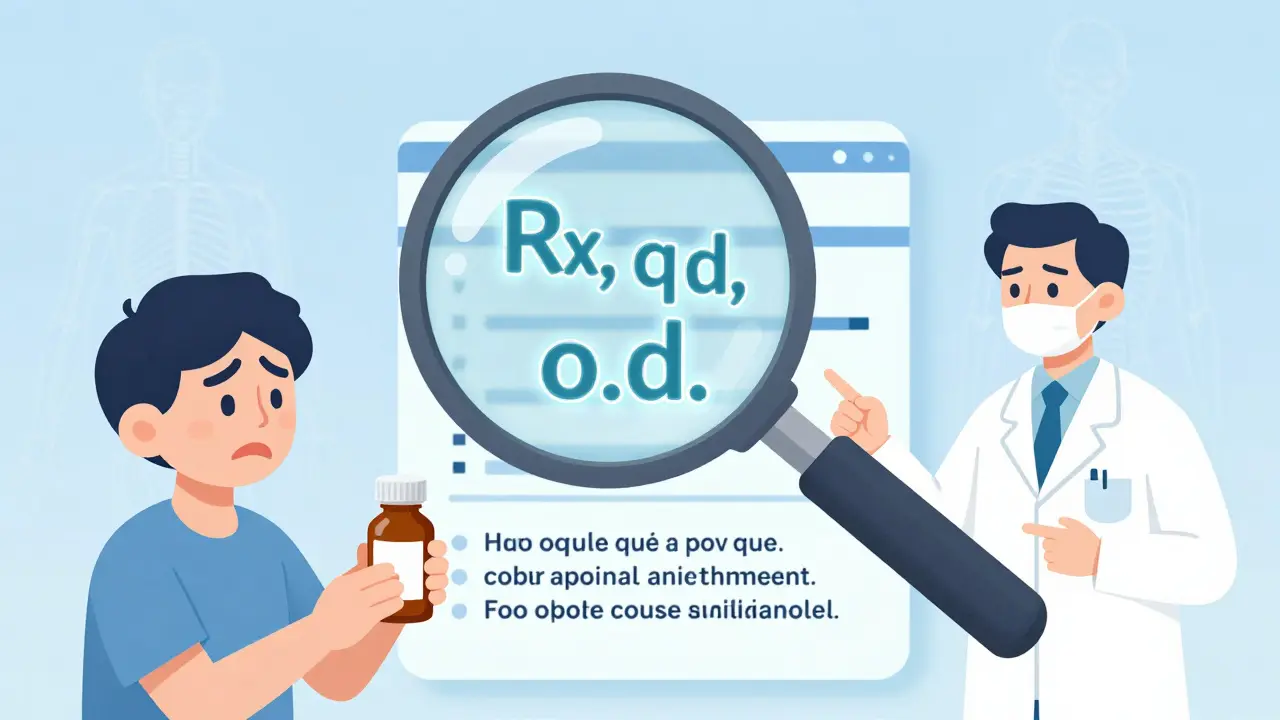
Ever looked at your prescription label and felt like you’re reading a secret code? That Rx symbol, the q.d., the o.d. - they’re not random. They’re shorthand. And if you don’t know what they mean, you’re guessing with your health.
These abbreviations and symbols have been around for centuries. Back in the 1500s, doctors wrote prescriptions in Latin so they’d be understood across Europe. Today, they’re still used - but they’re not as safe as they used to be. In fact, the Joint Commission says abbreviation-related mistakes cause nearly 7% of all medication errors in U.S. hospitals. That’s not a small number. It’s enough to land people in the ER - or worse.
What Does Rx Really Mean?
You see it on every prescription: Rx. It’s not a brand name or a code. It’s Latin. Short for recipe, which means “take.” It’s the doctor’s way of saying, “Take this.” You’ll also see it written as ℞ - that’s the old-fashioned symbol doctors used to scribble by hand. Even though most prescriptions are digital now, that symbol still shows up on labels.
But here’s the problem: people confuse Rx with “prescription” as a noun. It’s not. It’s an instruction. And if you think it means “refill” or “quantity,” you’re misreading it. That’s why pharmacies now write “Take as directed” right below the Rx symbol on your label - to make sure you don’t guess.
Common Dosage Abbreviations You’ll See
These are the ones you’ll find most often on your bottle:
- q.d. - means “daily.” But here’s the danger: it looks like q.i.d. (four times a day). A 2021 study found that 21.7% of errors happened because someone read q.d. as q.i.d. That’s how someone ends up taking four pills instead of one.
- b.i.d. - twice a day. Easy. But some doctors still write “BID” in all caps, which can look like “BID” as in “bid” - like a bid on an auction. Confusing? Yes.
- t.i.d. - three times a day.
- q.i.d. - four times a day.
- q.h. - every hour. But if you see “q4h,” that means every 4 hours. Don’t assume.
- PRN - “as needed.” Not “every day.” If your painkiller says “PRN,” don’t take it every 4 hours unless your doctor said so.
Here’s the kicker: the Joint Commission banned q.d. and QD in 2004 because of the confusion. They want you to see “daily” or “once daily.” But guess what? Many doctors still use the old abbreviations. That’s why your pharmacist has to double-check.
Route of Administration: How You Take the Medicine
It’s not just when you take it - it’s how.
- p.o. - by mouth. Latin for per os. This is the most common.
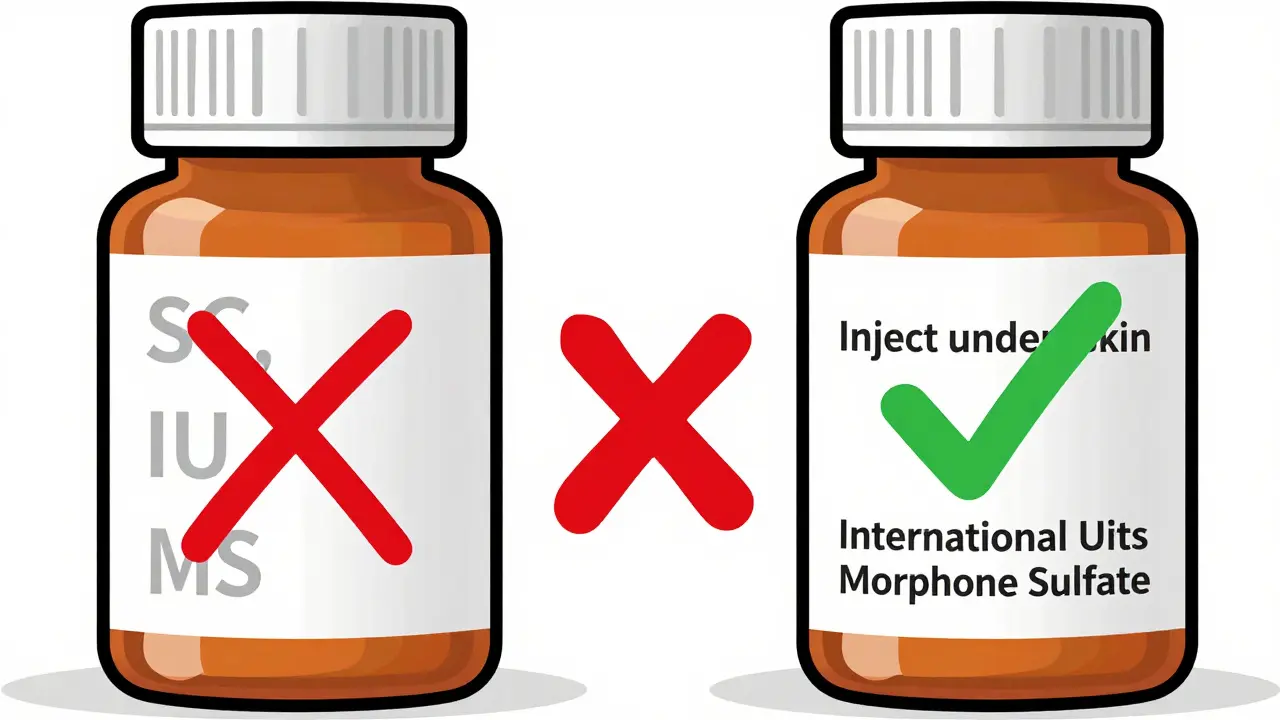
- SC or SubQ - under the skin. Used for insulin or blood thinners. Mistake this for “SL” (sublingual - under the tongue), and you could get a dangerous overdose.
- IV - into a vein. Only done in hospitals or clinics. If you see this on your home prescription, call the pharmacy. Something’s wrong.
- IM - into muscle. Common for vaccines or antibiotics.
- p.r. - rectally. Used for suppositories.
One real-life example: In 2023, a patient in Ohio took insulin sublingually because the label said “SC” and they thought it meant “under the tongue.” They ended up in the ER with dangerously low blood sugar. That’s why pharmacies now write “Inject under the skin” instead of “SC” on patient labels.
Eye and Ear Abbreviations: A Silent Danger
Eye drops and ear drops are especially risky. Here’s why:
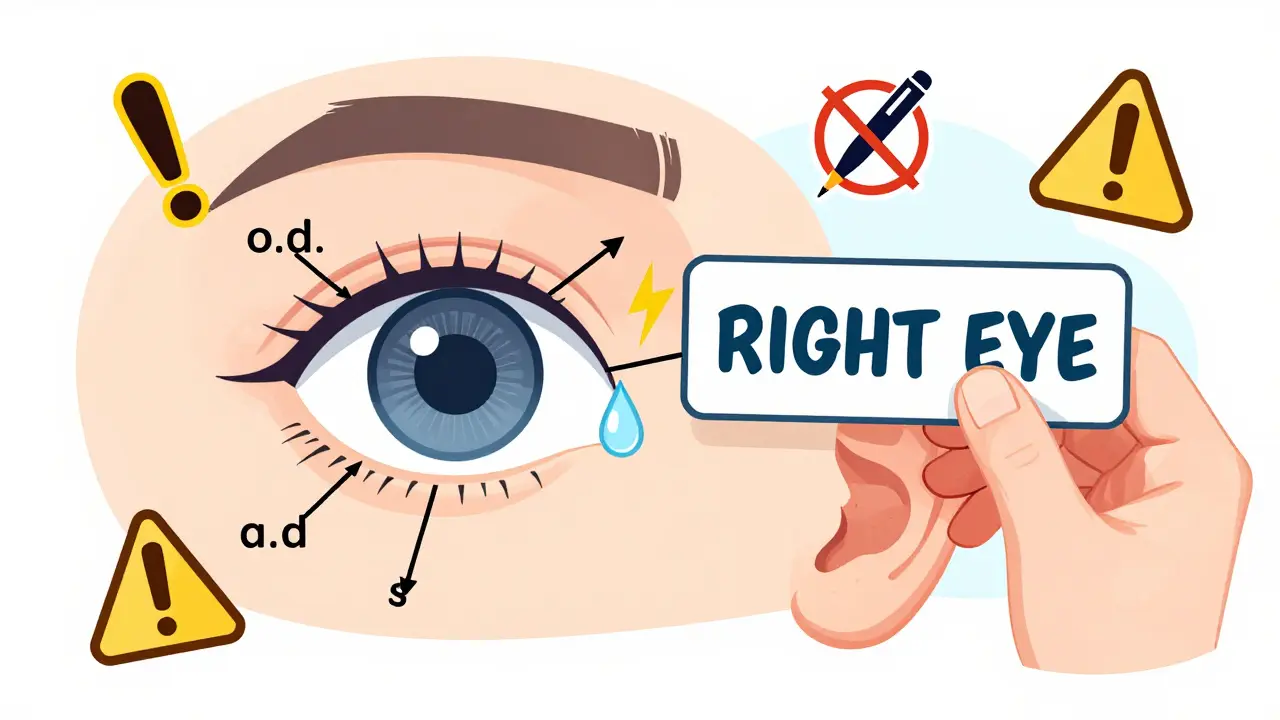
- o.d. - right eye (Latin: oculus dexter)
- o.s. - left eye (Latin: oculus sinister)
- a.d. - right ear (Latin: auris dexter)
- a.s. - left ear (Latin: auris sinister)
These look almost identical. And they’re often misread. The American Academy of Ophthalmology found that 12.3% of eye medication errors come from mixing up o.d. and o.s. One woman put glaucoma drops in her left eye when she was supposed to use them in her right - and lost vision in that eye.
Now, most pharmacies print “RIGHT EYE” or “LEFT EAR” on the label. But if you get a paper prescription from a doctor’s office, you might still see the Latin. Always ask: “Is this for my right eye or left?” Don’t assume.
The Dangerous Ones: What You Must Watch Out For
Some abbreviations are so risky, they’re banned - but they still show up.
- U - for “units.” Looks like a number 4 or the letter V. In Pennsylvania alone, 12 people died from insulin overdoses because someone read “5U” as “50.” Now, it must be written as “units.”
- MS - could mean morphine sulfate or magnesium sulfate. Two totally different drugs. One calms pain. The other treats heart rhythm problems. Mix them up, and you could stop breathing.
- IU - international units. Often confused with “IV” (intravenous). That’s how someone gets a powerful drug injected when they were supposed to take it by mouth.
- QOD - every other day. Looks like “QD.” People think it’s daily. They take it twice as often as they should.
- .0 - trailing zero. Like “5.0 mg.” That dot can be missed. So “5.0” becomes “50.” That’s why prescriptions now say “5 mg,” not “5.0 mg.”
These aren’t just “bad habits.” They’re life-threatening. The FDA is cracking down. By the end of 2025, all drug labels must remove these abbreviations. But until then - you need to be the last line of defense.
What Pharmacies Are Doing to Keep You Safe
Most pharmacies have systems in place to catch these mistakes.
- Electronic systems like Epic and Cerner automatically flag “U,” “MS,” and “QD” and force the doctor to rewrite it as “units,” “morphine sulfate,” or “daily.”
- At CVS and Walgreens, every prescription is checked by two people: the technician who fills it, and the pharmacist who reviews it.
- Walmart and Kroger now print all prescriptions in plain English. No Latin. No abbreviations. Just “Take one tablet by mouth twice daily.”
- Pharmacy technicians are required to pass tests on 72 core abbreviations to get certified.
But here’s the truth: if your doctor still writes “o.d.” on a paper script, and your pharmacy doesn’t catch it, you’re the one who has to speak up.
What You Should Do Right Now
You don’t need to memorize every Latin term. But you need to know how to protect yourself:
- Always read your label. If you see an abbreviation you don’t recognize - ask.
- Don’t assume. If it says “PRN,” ask: “What does that mean? When should I take it?”
- Compare the label to the doctor’s note. If the instructions don’t match, call the pharmacy.
- Use your phone. Take a picture of the label and send it to your pharmacist with a quick message: “Can you explain this?” Most will reply within minutes.
- Ask for plain English. Say: “Can you print this in words instead of abbreviations?” Most pharmacies will do it.
There’s no shame in asking. In fact, the most dangerous thing you can do is stay quiet. A 2023 survey of 4,850 pharmacy technicians found that 83.6% saw a dangerous abbreviation at least once a week. You’re not the only one confused. You’re just the one who can stop the mistake.
The Future: Why Abbreviations Are Disappearing
Change is coming - fast.
The World Health Organization wants all prescriptions in plain English by 2030. The U.S. Pharmacopeia made it official in May 2024: no more Latin on prescriptions unless it’s for units like mg or mL. AI systems like IBM Watson Health now auto-convert “q.i.d.” to “four times daily” with 99.2% accuracy.
But until that future arrives, you’re still the best safety net. Your eyes. Your questions. Your voice.
Prescription labels aren’t meant to be puzzles. They’re meant to keep you safe. And you don’t need a medical degree to understand them - just the courage to ask, “What does this mean?”
Dylan Smith
December 16, 2025 AT 20:16So Rx means take? That’s it? No wonder people mess up their meds
sue spark
December 18, 2025 AT 14:02I never realized how dangerous q.d. and q.i.d. look alike. My grandma took her insulin four times a day because she thought it said q.i.d. She ended up in the hospital. Never again.
Arun ana
December 20, 2025 AT 02:43Man I’ve been using my phone to snap pics of labels and texting my pharmacist. They always reply within 5 minutes. Seriously, do this. It’s free safety.
Joanna Ebizie
December 20, 2025 AT 23:43Of course doctors still use Latin. They think we’re stupid. Like we can’t handle plain English. It’s arrogance wrapped in a white coat.
SHAMSHEER SHAIKH
December 22, 2025 AT 15:52Let me share an experience: My cousin in Delhi was prescribed eye drops labeled 'o.d.' and applied them to the wrong eye - she lost partial vision for three weeks. The pharmacy had no English translation. This is not just an American problem - it’s global. We must demand clarity, not convenience.
Billy Poling
December 22, 2025 AT 18:23It is my professional opinion, based on over a decade of clinical documentation review and pharmacy protocol analysis, that the continued use of archaic Latin abbreviations in pharmaceutical labeling constitutes a systemic failure in patient safety infrastructure, particularly when juxtaposed against the demonstrable efficacy of standardized plain-language directives implemented in institutions such as Kaiser Permanente and the Veterans Health Administration, where error rates have decreased by up to 37% post-implementation. Furthermore, the psychological burden placed upon non-native English speakers who encounter these symbols without contextual support is both statistically significant and ethically indefensible.
Tiffany Machelski
December 24, 2025 AT 10:19i always ask for plain english but sometimes they forget to print it right and i dont want to look like a pain so i just take it and hope
Dave Alponvyr
December 25, 2025 AT 13:32So the whole system is built on guesswork and hope? Cool. I’ll just keep my meds in a bag labeled ‘blue pill = not death’.
Elizabeth Bauman
December 26, 2025 AT 22:50And yet the FDA is still letting Chinese and Indian manufacturers print these abbreviations on imported meds. It’s a national security issue. We’re letting foreign labs poison Americans with Latin codes because ‘tradition.’ Wake up people.
Souhardya Paul
December 27, 2025 AT 00:37My dad used to be a pharmacist in the 80s. He said back then, the real danger wasn’t the abbreviations - it was the handwriting. One guy got a dose of morphine because the doctor wrote ‘MS’ like a squiggle. He survived. The next guy didn’t. That’s why I’m glad they’re moving to digital. But we still have to be the eyes.
Josias Ariel Mahlangu
December 28, 2025 AT 13:26If you can’t read a label, you shouldn’t be taking pills. This isn’t rocket science. It’s basic responsibility. The system isn’t broken - you’re just lazy.