Combination NTI Drugs and Generic Availability: Coverage and Gaps
 Mar, 20 2026
When two drugs with razor-thin safety margins are combined, even small changes in how the body processes them can mean the difference between life and serious harm. This is the reality for patients taking combination NTI drugs - treatments that pair two or more Narrow Therapeutic Index medications. While single NTI drugs like warfarin or levothyroxine already demand careful monitoring, combining them multiplies the risk. And here’s the problem: almost none of these combination therapies have affordable generic versions available in the U.S., even though their individual components do.
What Makes a Drug an NTI Drug?
An NTI drug isn’t just any powerful medication. It’s one where the gap between a dose that works and a dose that harms is incredibly small. The FDA defines it as a drug where the difference between the minimum effective concentration and the minimum toxic concentration in the blood is less than twofold. That means if your blood level goes up just 10% too high, you could bleed internally. If it drops 10% too low, the treatment fails - and your condition worsens.
Common examples include warfarin (for blood clots), levothyroxine (for thyroid function), lithium (for bipolar disorder), digoxin (for heart rhythm), phenytoin (for seizures), and carbamazepine (for epilepsy and nerve pain). These drugs require regular blood tests - INR for warfarin, TSH for levothyroxine - to keep levels just right. Even then, patients often need frequent dose tweaks.
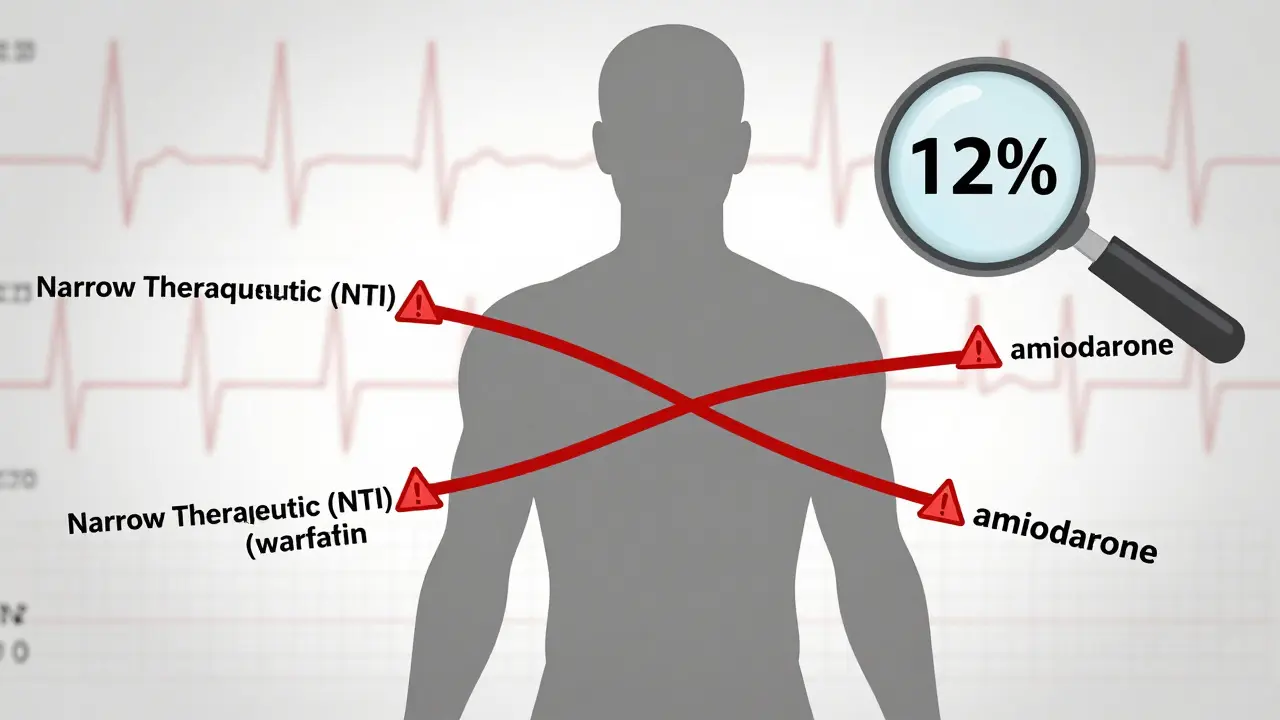
For combination therapy, this gets even trickier. Think of a heart patient on warfarin and amiodarone - both NTI drugs. One wrong generic switch in either drug can throw off the entire balance. That’s why the FDA tightened bioequivalence standards for NTI drugs in 2014 and again in 2022. For regular drugs, generics must match the brand within 80% to 125% of the original. For NTI drugs, that window shrinks to 90% to 111% for peak levels and 90% to 112% for total exposure. Still, when two NTI drugs are in one pill, those margins multiply.
Why Are Generic Combination NTI Drugs So Rare?
There are over 11 approved generic versions of warfarin. But not a single fixed-dose combination pill containing warfarin plus another NTI drug exists in the U.S. market. The same goes for lithium + anticonvulsant combos or phenytoin + levothyroxine combinations. Why?
The science says it’s nearly impossible to prove bioequivalence. A generic manufacturer must show that their version behaves exactly like the brand in every patient. For a single NTI drug, that’s hard enough. For two? Imagine trying to match two variables at once, where each one has its own narrow range. If one component is 5% off and the other is 7% off, the combined effect could be a 12% deviation - enough to trigger toxicity or treatment failure.
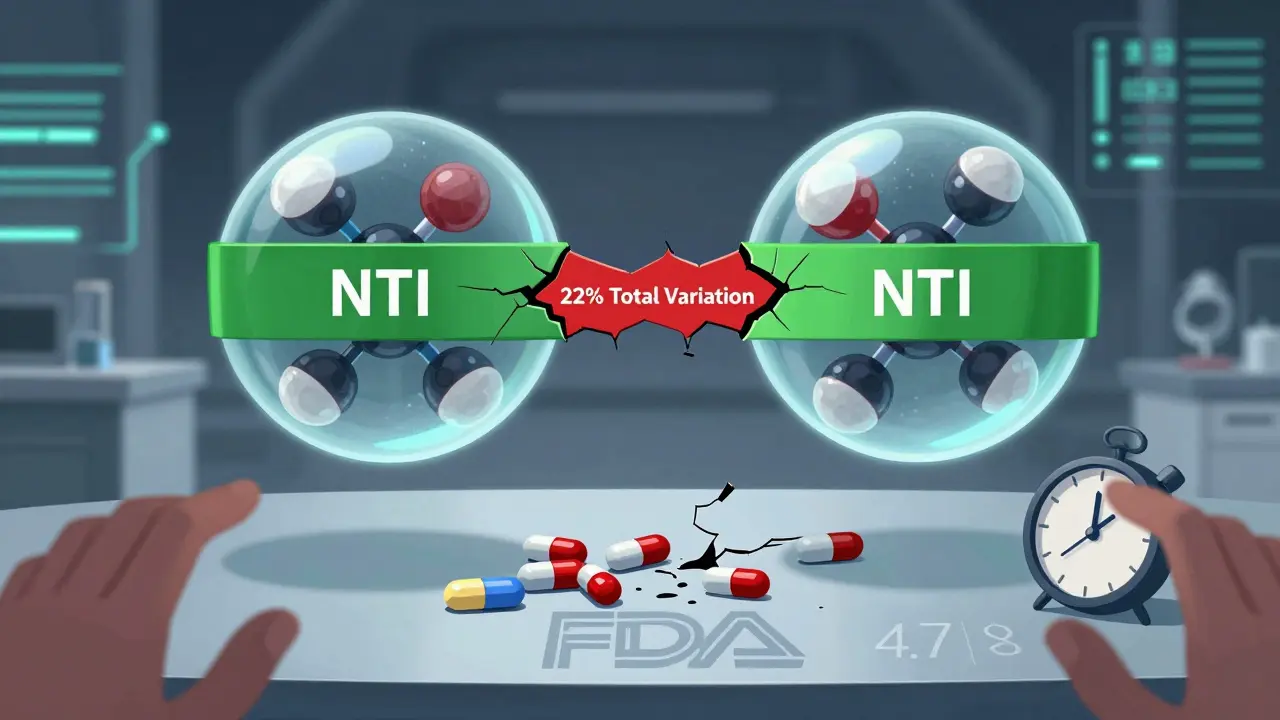
The FDA’s current standards don’t account for this compounding effect. A 2021 study in Nature Reviews Drug Discovery pointed out that even the tighter 90%-111% window allows a 22% total variation. When you combine two drugs with that much wiggle room, the risk isn’t just theoretical - it’s measurable.
Real-world data backs this up. A 2020 JAMA Internal Medicine study found that patients on combination therapies containing one NTI drug had 27% higher rates of adverse events after switching to generics, compared to 8% for non-NTI combos. Another survey of 1,247 patients on NTI combinations found that 63.4% reported problems after switching to generic versions - versus 18.2% on brand-name combinations. One patient on Reddit described going from a stable INR of 2.5 to 6.8 within days after a pharmacy switched to generic warfarin - a level that nearly killed him.
Who’s Affected and How?
This isn’t a niche issue. NTI drugs are used in heart disease, epilepsy, thyroid disorders, mental health, and cancer. Combination therapies are often the only way to control complex conditions. For example, in tuberculosis, isoniazid (an NTI drug) is paired with rifampin to prevent resistance. In cancer, methotrexate (NTI) is combined with other targeted agents. But when those combinations are branded, they’re expensive - sometimes over $1,000 a month.
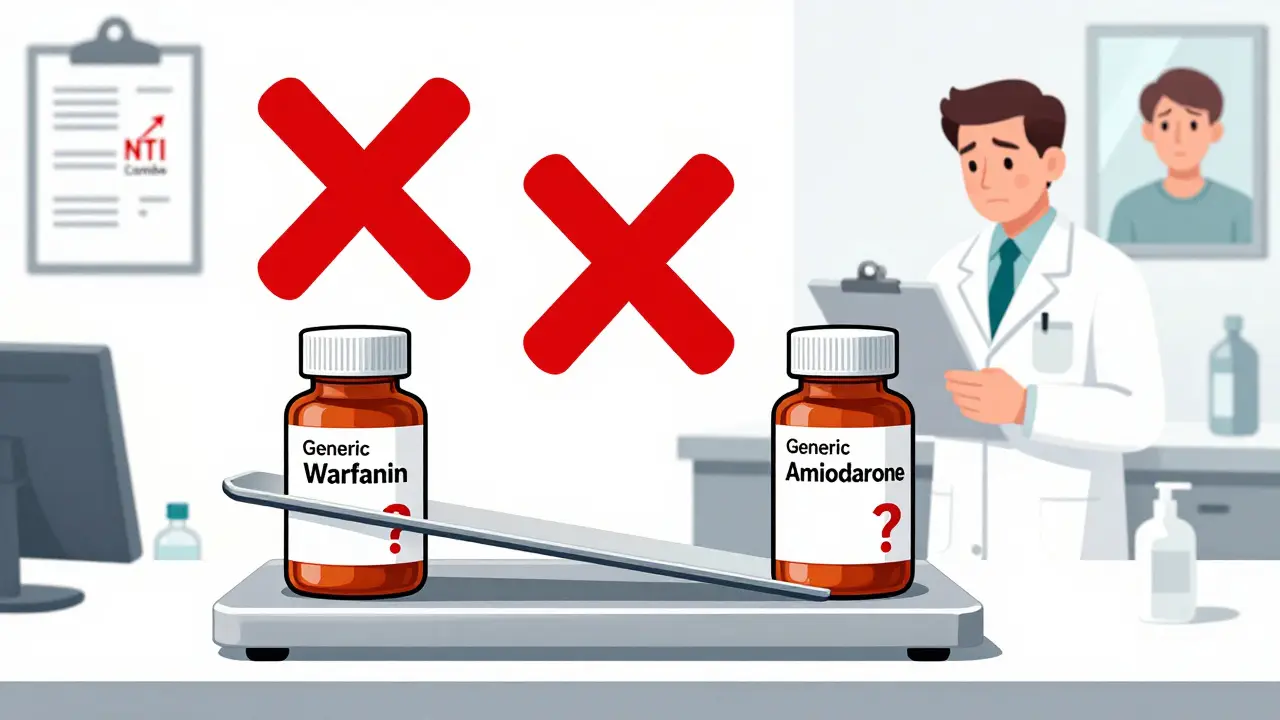
Patients on Medicare or Medicaid often can’t afford these prices. Many turn to pharmacy benefit managers who push generics - unaware that the generic for one component might be safe, but the combo isn’t. Pharmacists are caught in the middle. A 2023 ASHP survey of 856 pharmacists found 78.3% had seen therapeutic failure after generic substitution in NTI combinations. Over 40% reported serious adverse events, including hospitalizations.
Meanwhile, some patients do fine. A Reddit user on r/thyroid reported stable results on generic levothyroxine + selenium for two years. But those cases are rare - less than 15% of NTI combination scenarios, according to FDA adverse event data. Most patients aren’t that lucky.
The Cost of Monitoring and Management
If you’re on a combination NTI therapy, you’re not just paying for the pills. You’re paying for blood tests, specialist visits, and time.
Annual monitoring costs for these regimens average $1,200 to $2,500 - triple the cost of non-NTI combinations. Patients often need 6 to 8 weeks to stabilize after starting or switching. During that time, they may need 3 to 4 dose adjustments. That’s a lot of clinic visits, lab draws, and anxiety.
Pharmacists need specialized training to manage these cases. ASHP requires over 120 hours of focused education. Yet only 12 of 50 major U.S. academic medical centers have dedicated NTI combination therapy clinics. Most community pharmacies don’t have the staff, tools, or time to do it right.
Documentation is another gap. FDA-approved NTI monotherapy labels score 4.2 out of 5 for clarity. Combination products? Only 2.8. That means prescribers and pharmacists are working with incomplete or confusing instructions - increasing the chance of error.
Where the System Is Breaking Down
The market is clear: 87.4% of NTI monotherapy drugs have generics. Only 12.6% of combination regimens do. The FDA has approved over 11 generic versions of warfarin. But zero fixed-dose combos with warfarin. Same for lithium, phenytoin, carbamazepine. The gap isn’t small - it’s a chasm.
Regulatory delays are brutal. While non-NTI combination generics take 2.3 years to get approved, NTI combinations take 4.7 years on average. And even when they do get approved, manufacturers are hesitant. The cost of developing a combo NTI generic - with ultra-precise manufacturing and multiple clinical trials - can exceed $100 million. With such a tiny market share (less than 0.3% of the $48.7 billion NTI drug market), the return isn’t worth it.
Enterprise healthcare systems know this. They’re 3.2 times more likely than community pharmacies to block automatic substitution of NTI combinations. They’ve seen the data. They’ve seen the hospitalizations. But for many patients, especially those without good insurance, the choice is between no treatment and risky substitution.
What’s Next?
The FDA is trying. In February 2023, it released draft guidance proposing even tighter bioequivalence standards for combination NTI drugs: 90% to 107.69% for peak levels and 90% to 110% for total exposure. The European Medicines Agency adopted similar rules in January 2023. These are steps forward - but they still don’t solve the core problem: how do you prove two narrow-window drugs behave the same together?
Some experts believe advances in manufacturing precision, like real-time monitoring and AI-driven dosing, could eventually make it possible. Others, like Dr. Lewis Nelson of NYU, argue that the pharmacokinetic challenges are fundamental. Combining two drugs with minimal safety margins may simply be too unpredictable to ever be reliably replicated.
The FDA’s 2024 pilot program for “precision bioequivalence” using pharmacometric modeling could be a game-changer. It would test how drugs behave in virtual patient populations instead of relying on small clinical trials. If successful, it might open the door to safer generics.
Until then, patients are stuck. They’re paying more for branded drugs. They’re getting less consistent care. And they’re taking risks that aren’t fully understood - or disclosed.
Frequently Asked Questions
What are combination NTI drugs?
Combination NTI drugs are treatments that combine two or more medications, each with a narrow therapeutic index - meaning the difference between a safe dose and a toxic one is very small. Examples include warfarin plus amiodarone, or lithium plus valproate. These are used for complex conditions like heart rhythm disorders, epilepsy, or bipolar disorder where single-drug therapy isn’t enough. But because both drugs have tight safety margins, even small changes in how the body absorbs or processes either one can lead to serious side effects or treatment failure.
Why don’t generic versions of combination NTI drugs exist in the U.S.?
There are two main reasons. First, proving bioequivalence is scientifically near-impossible. Each NTI drug must meet strict standards (90%-111% for peak levels), but when two are combined, their variations multiply. A 5% difference in one and a 6% difference in the other can create a 12% total deviation - enough to cause harm. Second, the cost to develop and test these combinations is extremely high, and the market is tiny. With less than 0.3% of the NTI drug market being combination products, manufacturers don’t see a return on investment.
Are there any safe generic combination NTI drugs available anywhere?
In Europe, some generic combinations of levothyroxine and selenium have been used since 2015 with reported adverse event rates under 2%. But these are exceptions. Most combination NTI therapies - especially those involving warfarin, lithium, or phenytoin - still lack approved generic versions even in Europe. The U.S. has no approved combination NTI generics. The difference in outcomes between regions may reflect stricter monitoring and better patient education in Europe, not necessarily better science.
How do I know if I’m on a combination NTI therapy?
Check your prescription. If you’re taking two or more medications that are individually classified as NTI drugs - like warfarin, levothyroxine, lithium, digoxin, phenytoin, or carbamazepine - you’re likely on a combination NTI regimen. Ask your pharmacist or prescriber. You can also look up your drugs on the FDA’s Orange Book or the ASHP NTI Drug List. If your pharmacy switches one component to a generic without telling you, that’s a red flag. Always verify that both drugs in the combo are the same brand or have been cleared for substitution.
What should I do if my pharmacy switches my combination NTI drugs to generics?
Do not accept the switch without talking to your doctor. Ask them to write "Do Not Substitute" or "Dispense as Written" on the prescription. If you’ve already switched and feel off - dizzy, fatigued, bruising easily, or having heart palpitations - get your blood tested immediately. For warfarin, check your INR. For levothyroxine, check your TSH. Report the incident to your prescriber and to the FDA’s MedWatch system. Many patients don’t realize they’re at risk because the changes are subtle. Don’t wait for a crisis - act early.
Nicole James
March 21, 2026 AT 03:31They’re not just avoiding generics-they’re hiding something. Have you ever wondered why Big Pharma lobbies so hard to keep these combo drugs patent-locked? It’s not about safety-it’s about control. The FDA’s “tighter standards” are a smokescreen. Real bioequivalence? Impossible. But they’ll make you believe it’s science when it’s really corporate calculus. Every time you get switched to a generic, it’s a silent experiment. And you’re the lab rat. Don’t trust the system. It’s rigged. Always.
Nishan Basnet
March 22, 2026 AT 17:30This is one of those issues that sits at the intersection of medicine, economics, and human dignity. The fact that we can mass-produce smartphones with nanometer precision but can’t reliably replicate a pill that saves lives speaks volumes about our priorities. A patient on warfarin and levothyroxine isn’t just managing two conditions-they’re dancing on a razor’s edge, and the system has removed the guardrails. It’s not merely a regulatory gap; it’s a moral failure. We must demand better-not because it’s profitable, but because it’s right.
Bryan Woody
March 22, 2026 AT 19:44Let’s be real-this whole NTI combo thing is a nightmare waiting to happen and nobody wants to touch it because it’s too expensive and too risky. So we got patients stuck paying $1200/month for pills that should cost $12. Meanwhile, the FDA sits there with their clipboard saying "we’re working on it" like that’s gonna fix a heart attack in three weeks. The only reason this isn’t a national scandal is because the people affected are too old, too sick, or too broke to scream loud enough. Wake up. This is the healthcare equivalent of letting a toddler drive a semi. And yeah, I’m salty. You should be too.
matthew runcie
March 23, 2026 AT 01:45I’ve been on a combo NTI regimen for 7 years. It’s been rocky, but I’ve learned to read the signs. Fatigue, weird bruising, brain fog-those aren’t just "off days." They’re red flags. I always call my pharmacist before any switch. I ask for the lot number. I track my labs like a hawk. It’s a lot of work. But I’m alive. So yeah, the system sucks-but you can still fight it. Stay vigilant. Your life depends on it.
Paul Cuccurullo
March 23, 2026 AT 17:10The tragedy of this situation is not merely clinical-it is existential. To be reduced to a statistical outlier in a pharmaceutical ledger is to be dehumanized by bureaucracy. The patient who must monitor INR every Tuesday, who wakes up dreading the next pharmacy substitution, who stares at a $987 co-pay and wonders if they’ll live to see next month-this is not healthcare. This is performance art. And the audience? The shareholders.
Solomon Kindie
March 24, 2026 AT 05:00Timothy Olcott
March 24, 2026 AT 21:45Jackie Tucker
March 25, 2026 AT 17:36How quaint. A 1200-word treatise on pharmaceutical logistics, and not a single mention of the fact that patients in countries with universal healthcare don’t have to choose between rent and their heart medication. We’re not debating science here. We’re debating whether human life is a cost center or a moral imperative. The answer, as always, is written in the margins of insurance claims. I’m just here for the popcorn.